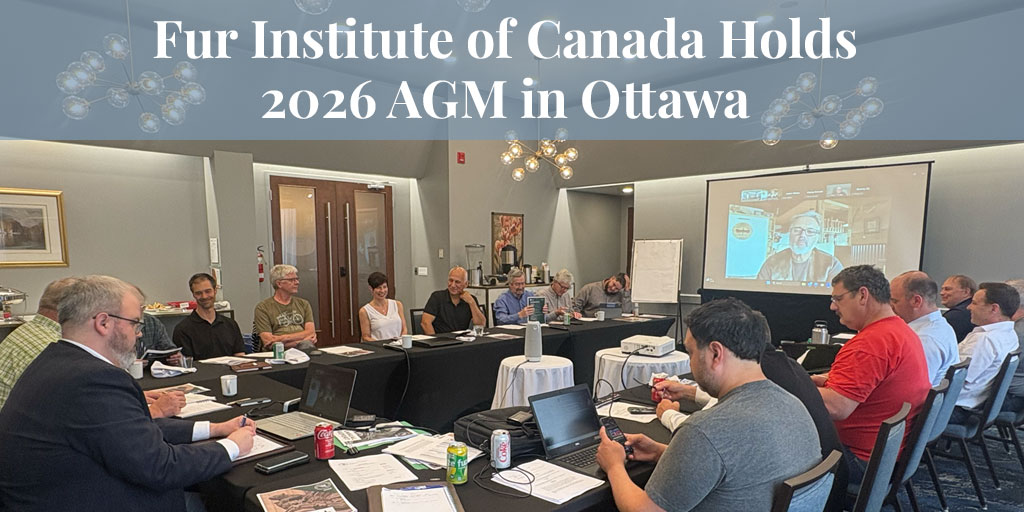
This year the Lord Elgin Hotel in Ottawa was the venue for the 2026 Annual General Meeting of the Fur… Read More
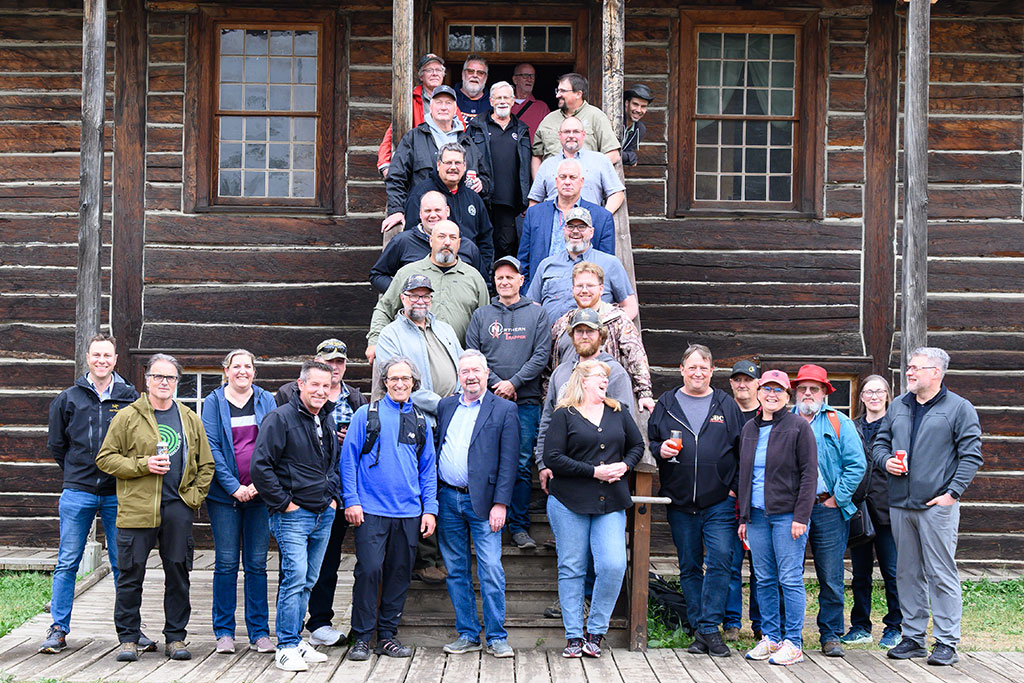
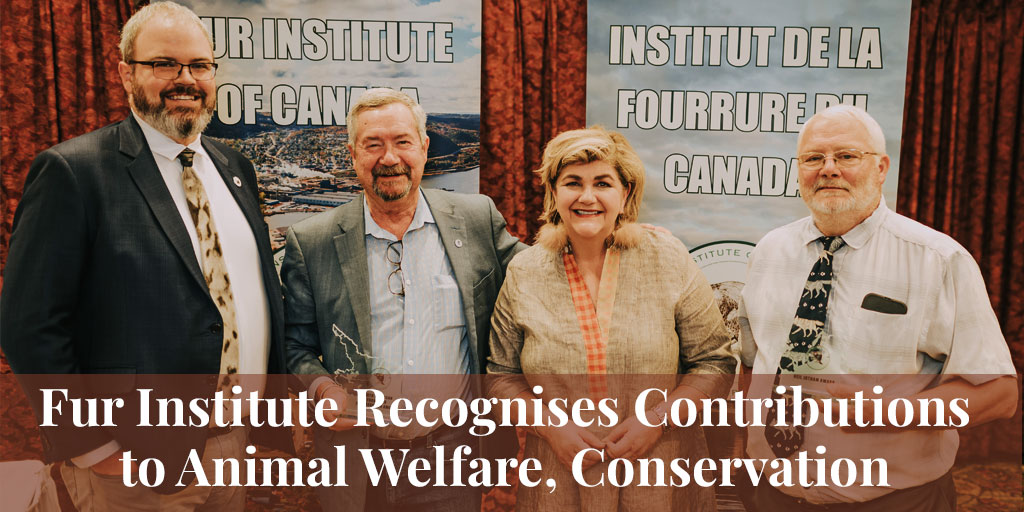
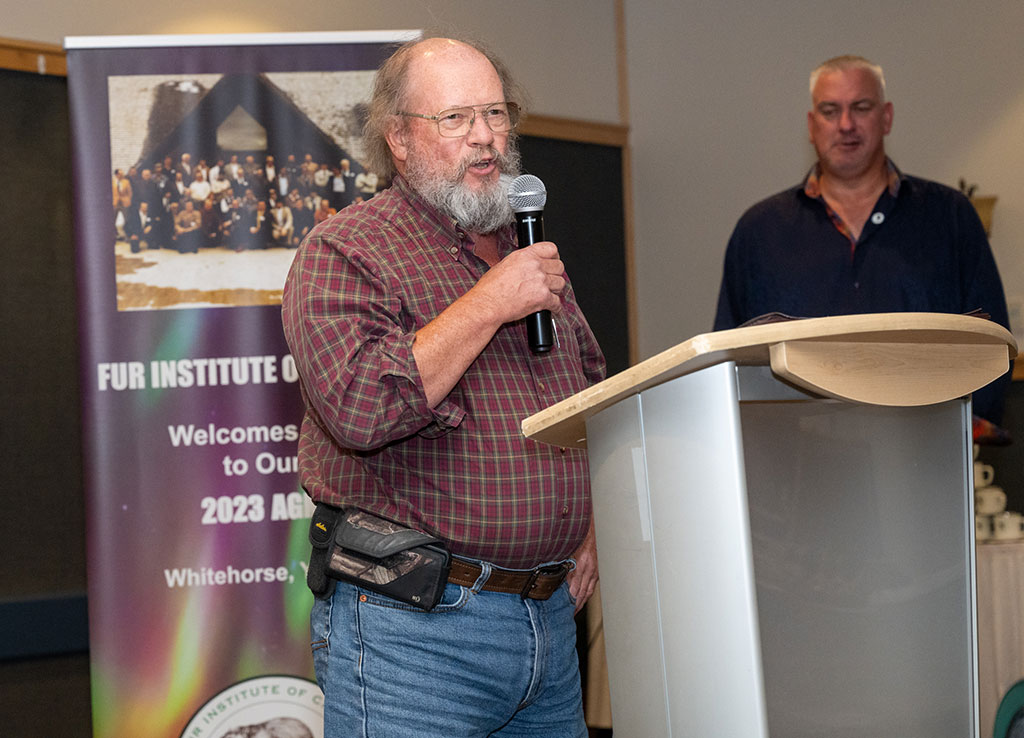
This year the Lord Elgin Hotel in Ottawa was the venue for the 2026 Annual General Meeting of the Fur Institute of Canada (FIC). June 18-19 were reserved for the meeting proper, while preceding days were allocated to three committees: the Canadian Furbearer Management Committee (CFMC), the FIC's Trap Research & Development Committee (TRDC), and the FIC Communications Committee.
The CFMC consists of government wildlife managers, and focuses on provincial / territorial collaboration among regulators and trapping associations. The TRDC, a committee of the FIC, focuses on the latest developments in humane trapping, and the Communications Committee guides the FIC’s public engagement.
"All these committees play essential roles in guiding the work of the FIC," said Executive Director Doug Chiasson, "and it was great to have so many representatives here in Ottawa."
River Cruise
https://youtu.be/4nSLQ3K9W0Q
A cruise on the Rideau Canal provided an important bonding activity for delegates. Video: Jason Parker.
As a social activity, the evening of June 18 was given over to a dinner cruise on the Rideau Canal, an important trade route for fur along the Ottawa River in the 19th century.
With delegates to the FIC's AGMs coming from across Canada, they rarely get the chance to meet face to face, so such activities are important opportunities to connect outside of the formal meetings on the agenda.
Banquet and Awards
https://youtu.be/Og05p2OnYPM?si=9TNoBvj871HkJbSe
Keynote speaker MP Ernie Klassen does not have a background in fur, but is a fast learner. Video: Jason Parker.
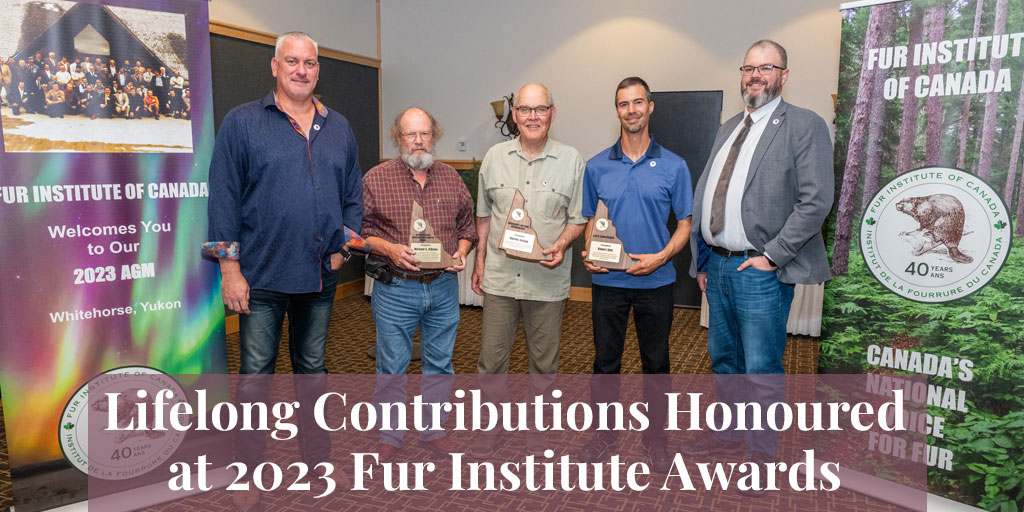
Following the conclusion of the AGM, on the evening of June 19 the FIC hosted a banquet and award ceremony.
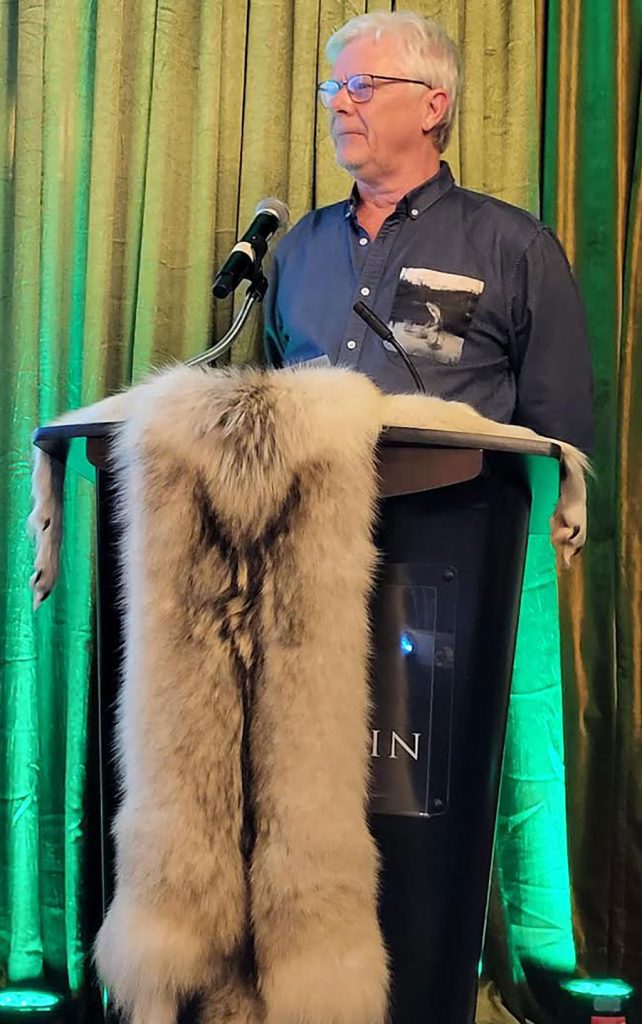
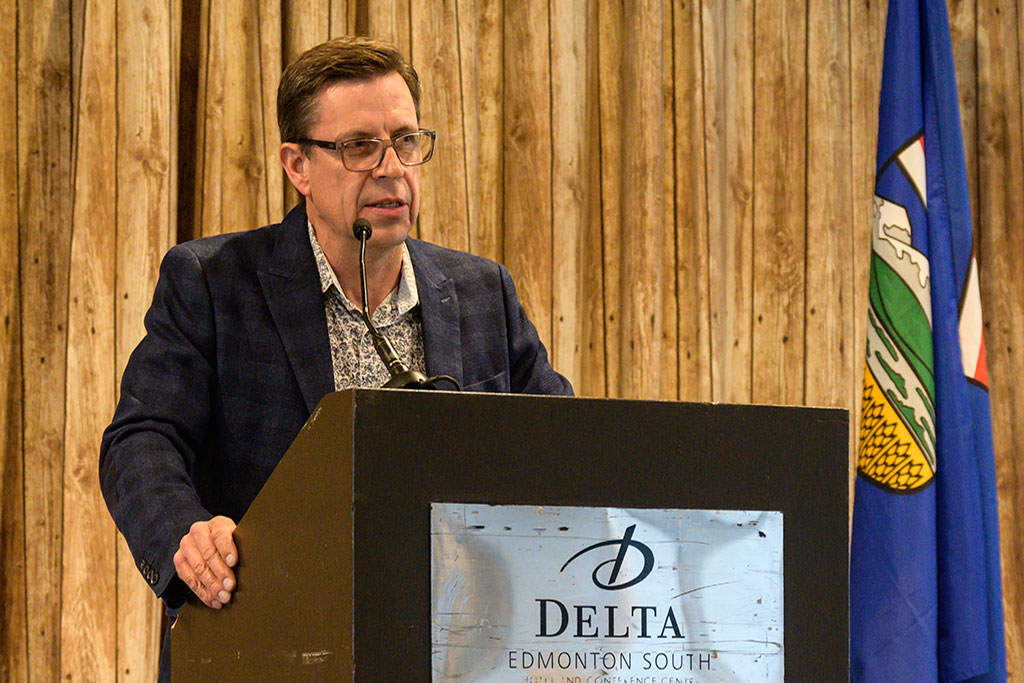
The keynote speech was given by Liberal MP for South Surrey-White Rock and Parliamentary Secretary to the Minister of Fisheries, Ernie Klassen. Ernie is a newcomer to the world of politics, elected for the first time in 2025, but he's a fast learner, having attended the FIC’s Fur Day on the Hill earlier this year as well. "I have learned so much about this industry," he said, "and I take my hat off to all the volunteers and people within this industry who ... contribute to the economy of Canada."
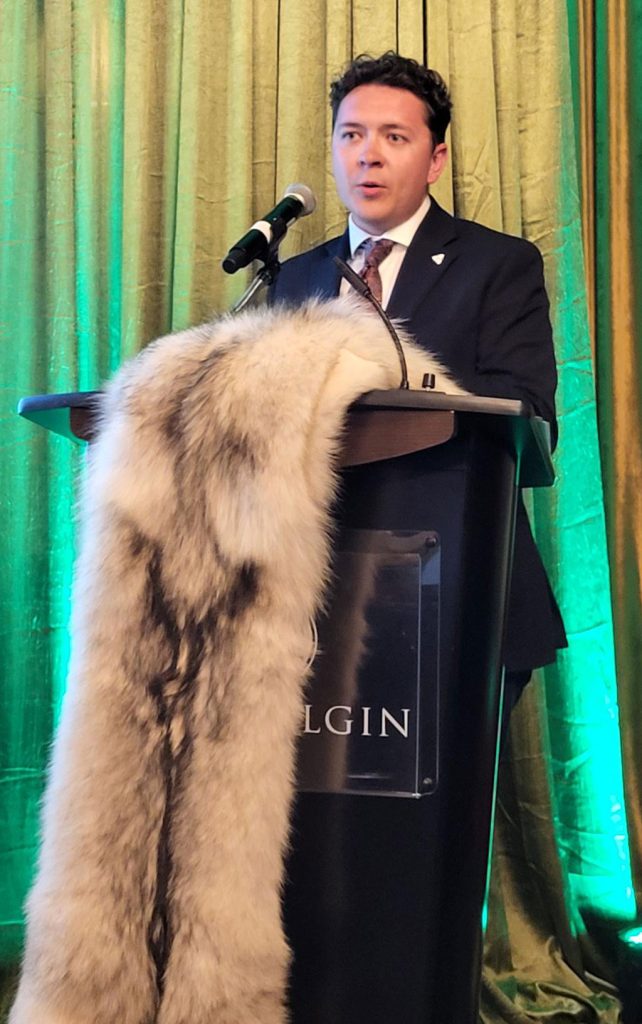
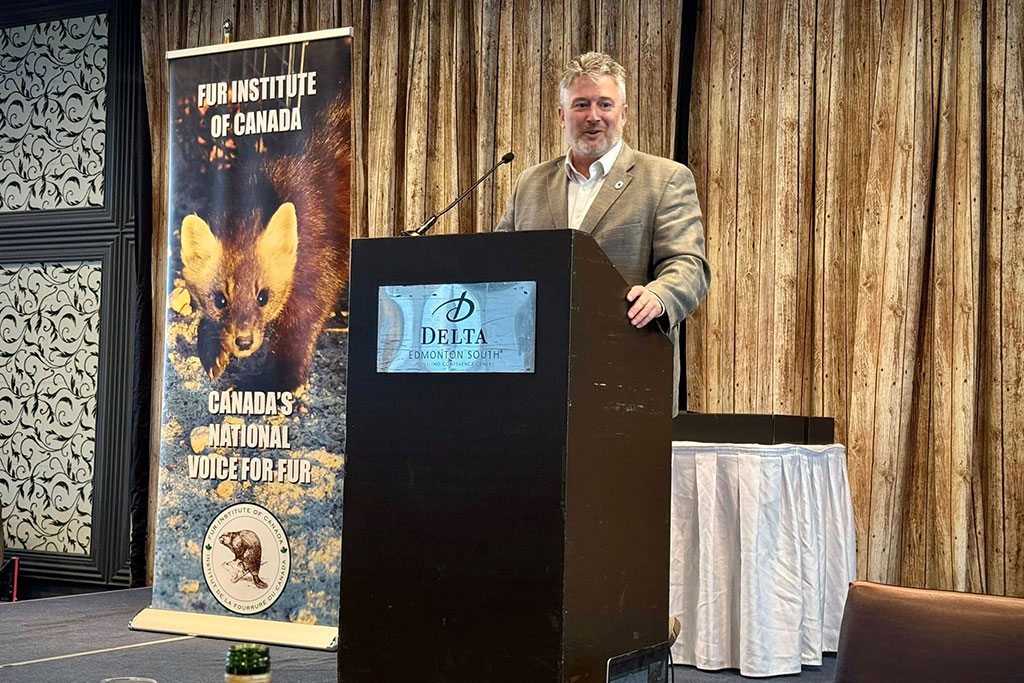
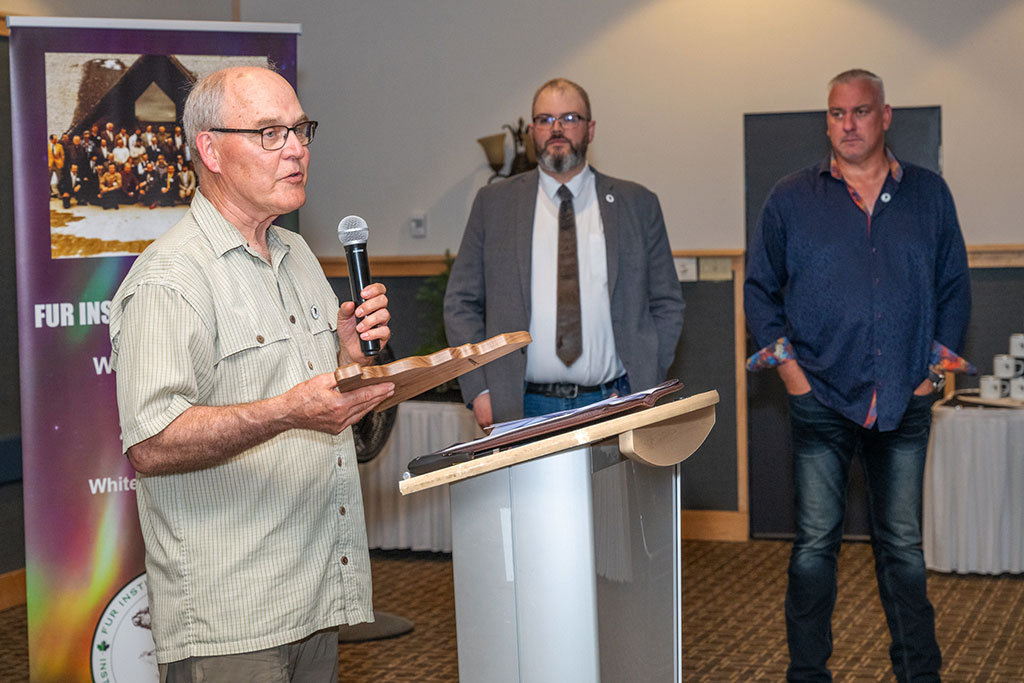
Also there to address the gathering was Billy Denault, MPP for Renfrew-Nippissing-Pembroke, speaking on behalf of Ontario Minister of Natural Resources Mike Harris Jr..
https://youtu.be/JNr8QRA-adU
Master of ceremonies at our awards presentation was Mike O'Brien. Video: Jason Parker.
For the presentation of awards, FIC's First Vice-Chair, Mike O'Brien, assumed the role of master of ceremonies.
First, Mike awarded and accepted the Lifetime Achievement Award on behalf of his old friend, Paul Tufts, who passed away in August 2025. Paul was an avid trapper, educator, and part-time fox farmer, who worked as a government wildlife biologist from 1967 until his retirement in 1994. He served on the Board of the Trappers Association of Nova Scotia from 1973 to 2008 (including a decade as its president), and also on the Board of the FIC.
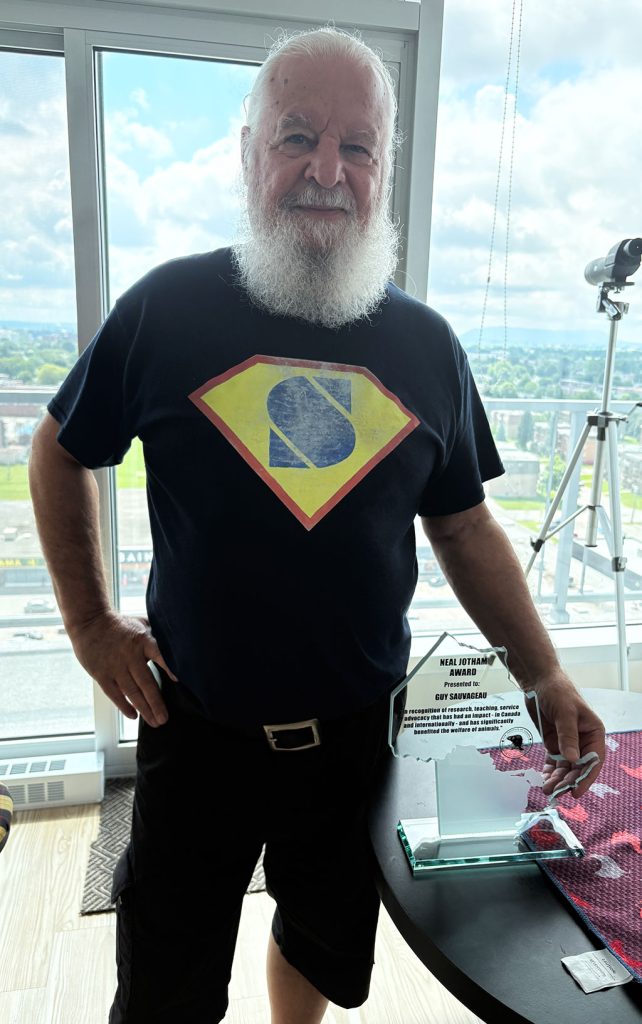
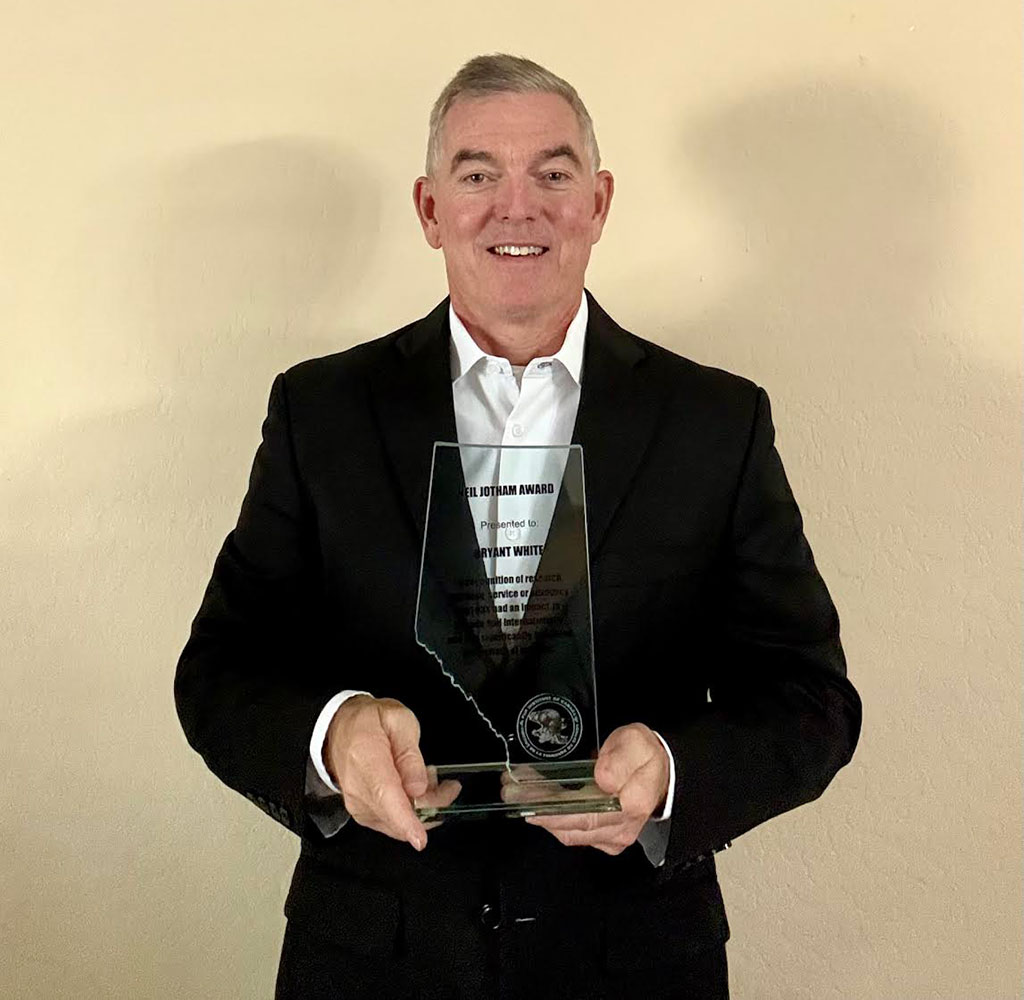
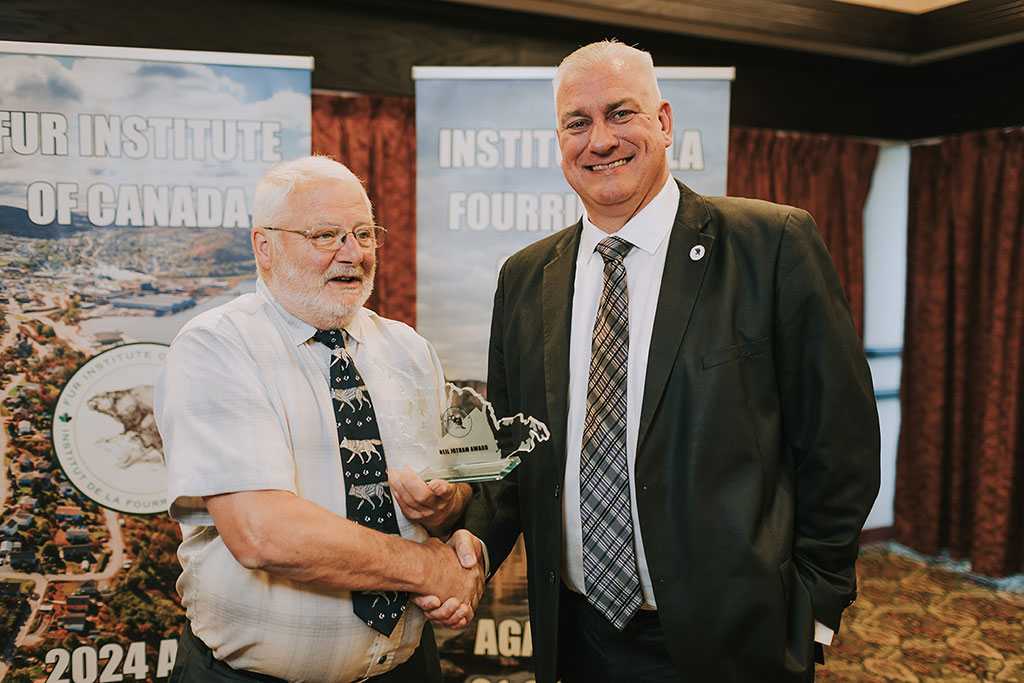
Next, Pierre Canac-Marquis, Trap Research and Certification Coordinator for the FIC, presented and received the Neal Jotham Award on behalf of Guy Sauvageau. First given in 2014, the award recognises Neal Jotham's leadership in the creation of an international standard for humane trapping systems, and his contributions to improved animal welfare.
A native of Quebec, Guy was responsible in the 1970s for making the world's first commercial killing trap that could be considered humane by modern standards. With such features as tight-closing jaws and a strong, oversized spring for clamping force, refined versions of the Sauvageau C120 Magnum are still used today for marten, mink, and other furbearers. This was "a major accomplishment," said Pierre. "We went from the Stone Age to the Modern Age because of this trap."
MPP Billy Denault
Pierre Canac-Marquis
Guy Sauvageau
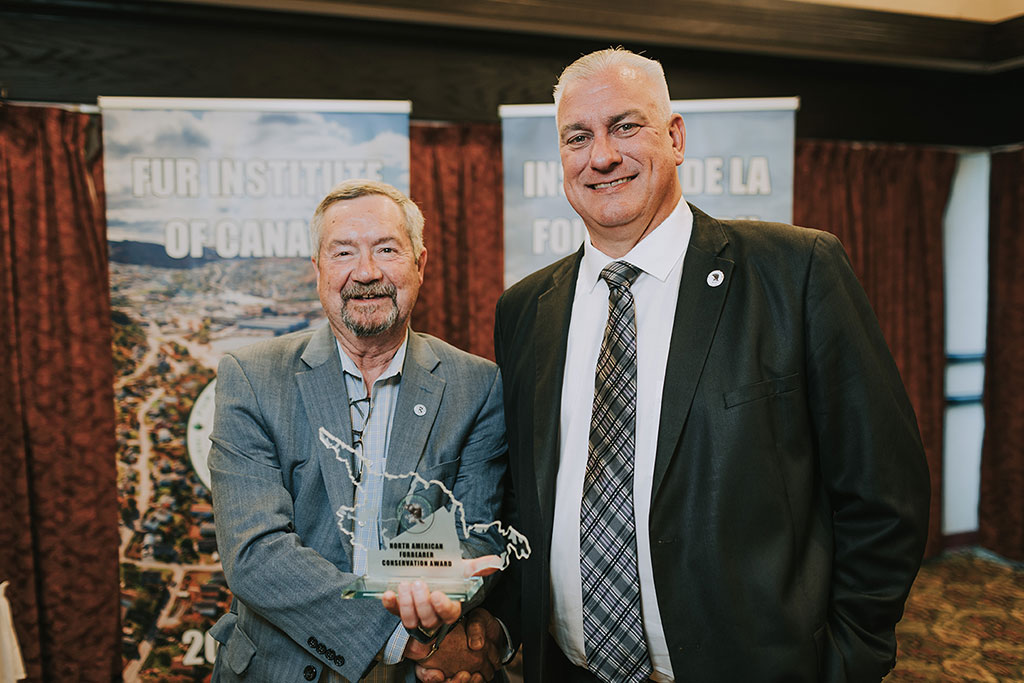
Then Trevor Wilkie, of the Trappers Association of Nova Scotia, presented this year's Lloyd Cook Award. Inaugurated in 1991, this award honours Lloyd Cook's commitment to excellence in trapping, trapper education and public understanding of wildlife management.
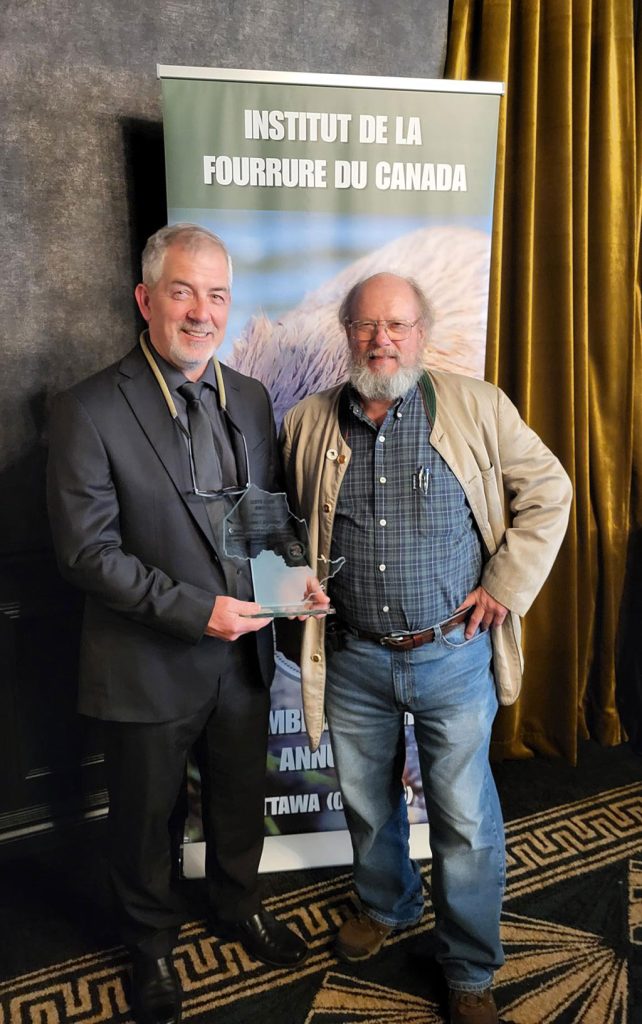
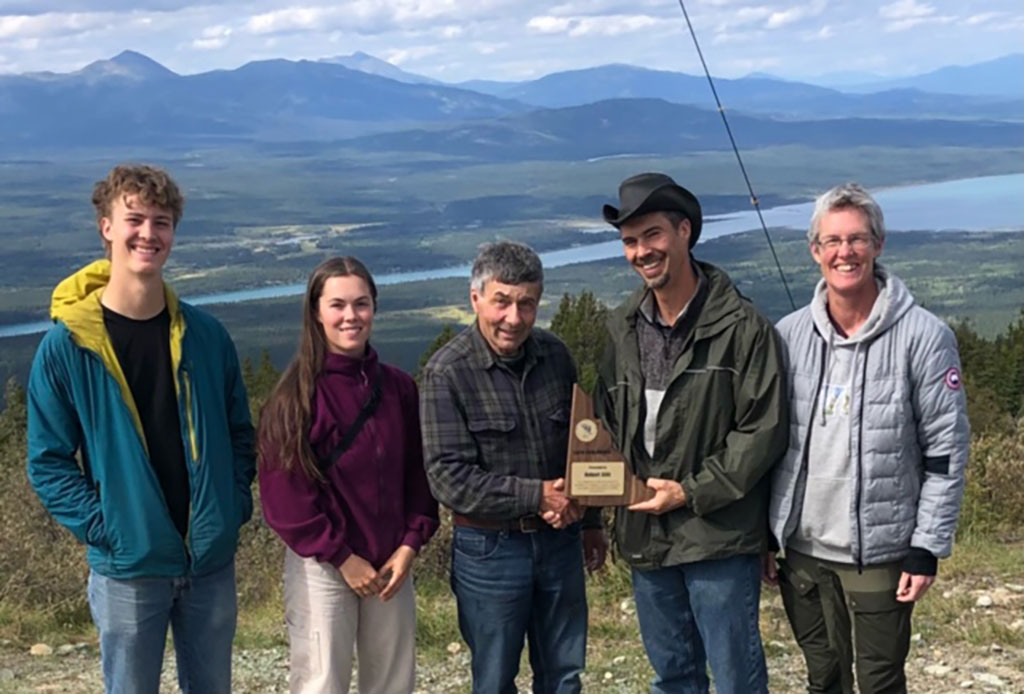
Winner of this year's award was Mike Boudreau, a wildlife manager with Nova Scotia's Department of Natural Resources from 1989 until his retirement in 2022. Mike started as an assistant conservation officer, then became a furbearer and upland game specialist, and finally transitioned into a human-wildlife conflict biologist. During all this time, he's been "a huge supporter" of trappers, said Trevor. "He's been a tremendous resource for our association, members of the province in general, and still to this day we constantly call him and ask for advice."
Mike Boudreau and Mike O'Brien
David Bosma
Howard Noseworthy and Robin Horwath
Next, Howard Noseworthy of Fur Harvesters Auction named David Bosma as the recipient of this year's Jim Bourque Memorial Award, David having passed away in May 2025. The award, presented since 1997, recognises its namesake's commitment to the sustainable use of wildlife resources, improved animal welfare, the development of Canada’s modern fur trade, the recognition of Indigenous People’s cultures and the stewardship role that trappers play in the conservation and management of Canada’s wildlife.
David joined the fur trade as a teenager with the Hudson's Bay auction house, before moving on to the Ontario Trappers Association and the Seattle Fur Exchange, and ending his long career at FHA. As FHA's CEO Mark Downey said in an obituary, "Dave’s true claim to fame as a LIFER in this fur trade was his vast knowledge and versatility in being able to confidently grade any and all species exceptionally well."
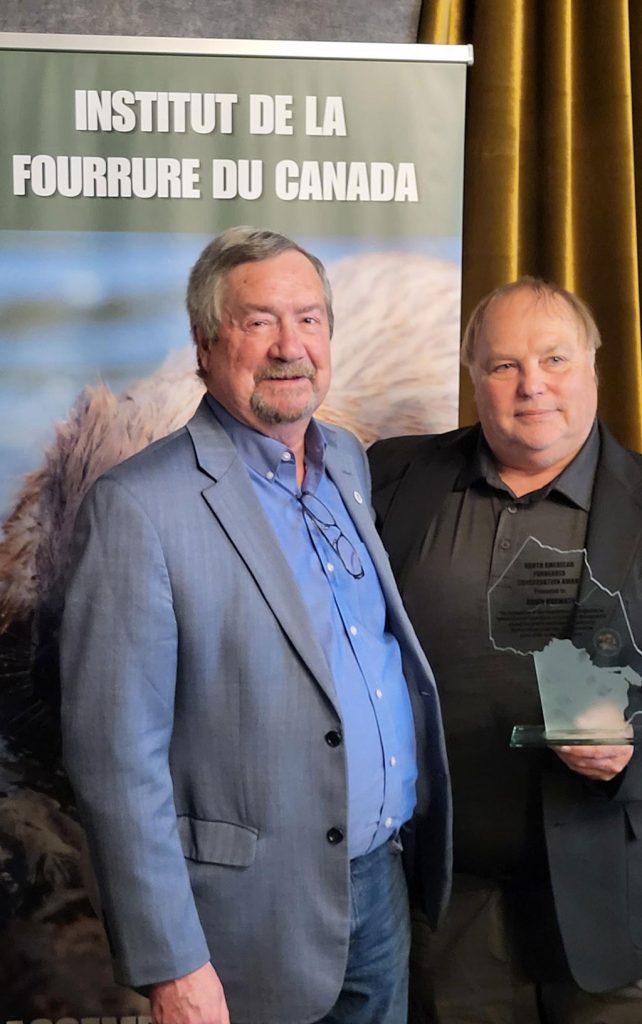
Last but not least, Howard also presented this year's North American Furbearer Conservation Award, to promote awareness and recognition of individuals and organizations that have made significant efforts for sustainable furbearer management. This year's winner was Ontario native and former FIC chair, Robin Horwath.
Robin has a long track record of dedication to trapping and furbearer management, but Howard chose to highlight Robin's constant "search for the truth". And the memory that "strikes closest to my heart" is the case of the so-called "Algonquin wolf". Robin "was never willing to accept that a wolf that didn't at least live on an island, could somehow be completely separated from all the other wolves that surrounded it." (If you're unfamiliar with this case, Robin spells it out in the blog post below.)
In early June, the Canadian Wildlife Conservation Partners (CWCP) held its first in-person meeting, in Ottawa, to discuss the new… Read More
The CWCP already represents over a million Canadians. Photo: Darryn Epp.
In early June, the Canadian Wildlife Conservation Partners (CWCP) held its first in-person meeting, in Ottawa, to discuss the new consortium's rapid growth, and how it plans to be a powerful advocate for hunters and trappers.
All organizations participating in the CWCP share the goals of wanting to conserve wildlife and their habitats through science-based management, safeguarding biodiversity, and defending the rights and traditions of Canada's hunters, trappers, and other outdoor enthusiasts. Its guiding principles and rules of engagement respect the autonomy of each organization while coordinating advocacy efforts on issues of national and provincial importance.
Chairing the Steering Committee is Chris Everett, Chapter/Advocacy Services Specialist-Canada for Safari Club International-Canada. Assisting her as vice-chair is Brian McCrae, Director of Government Affairs-Canada for Delta Waterfowl, joined by Kyle Stelter, CEO of the Wild Sheep Society, and Doug Chiasson, Executive Director of the FIC.
Growing Participation
"The need for outdoors advocacy organizations to band together to stand up for our outdoors heritage is bigger than ever," says CWCP chair Chris Everett.
In just nine months, membership has grown from these four founding organizations to 24 partners and five affiliates today (see below). Not only are they spread across the land, they are also diverse, including trapping and hunting organizations, outfitters, and wildlife federations.
“The need for outdoors advocacy organizations to band together to stand up for our outdoors heritage is bigger than ever," says Chris Everett. "I’m proud to be part of a team that is turning ideas and words into action. The CWCP collectively represents over 1 million Canadians, and will continue to encourage governments to ensure conservation of wildlife and respect for our heritage activities is top of mind when making policy decisions.”
Brian McRae is totally on-board. “Delta Waterfowl is proud to be one of the founding members of the CWCP, uniting hunting, trapping and conservation organizations from coast to coast to coast," he says. "Through collaboration, the CWCP will continue to engage with our governments on topics of provincial and national importance to ensure the voices of our communities are heard as it relates to our outdoor heritage activities.”
Kyle Stelter is also committed. “As a founding member of the CWCP, the Wild Sheep Society of British Columbia is proud to stand alongside like-minded organizations from across the country," says Kyle. "CWCP, as Canada’s largest conservation collaborative, works to advance science-based wildlife conservation, protect our outdoor heritage, and develop practical solutions for habitat, hunting, trapping, and the outdoor community."
And Doug Chiasson is a firm believer. "The CWCP is an exciting forum through which organizations from across the sustainable use space in Canada will be able to collaborate and cooperate," he says. "By working together, I think we can really start to finally make sure that hunting, trapping and sustainable use of wildlife issues punch through to the forefront for federal and provincial decision-makers, instead of being stuck on the edge of someone’s desk."
Current Members
Partner organizations are cordially invited to join the CWCP, providing only that they share its values. Following are its current partners and associates. If your organization is not among them, now is the time to join!
Consumers are receiving mixed signals, with some saying fur is back and others saying it’s on its last legs. So… Read More
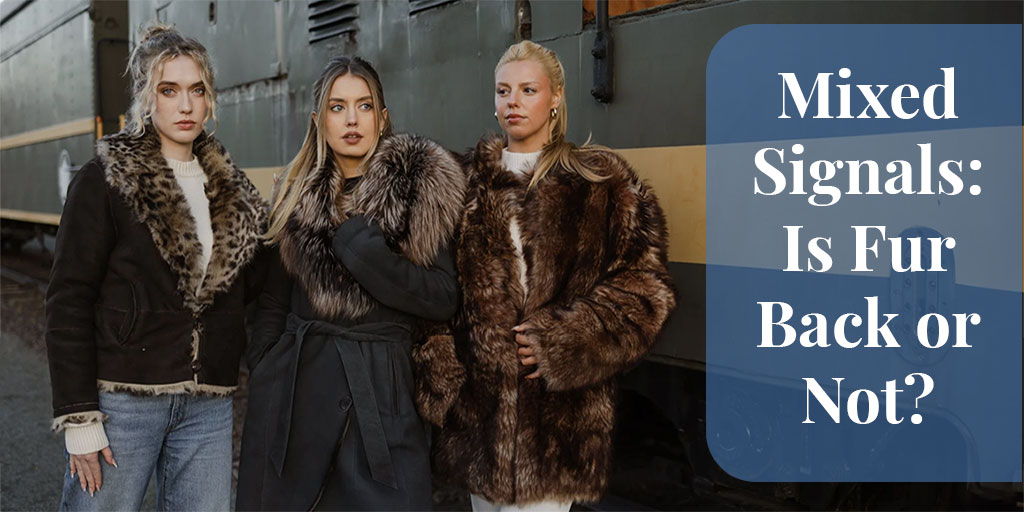
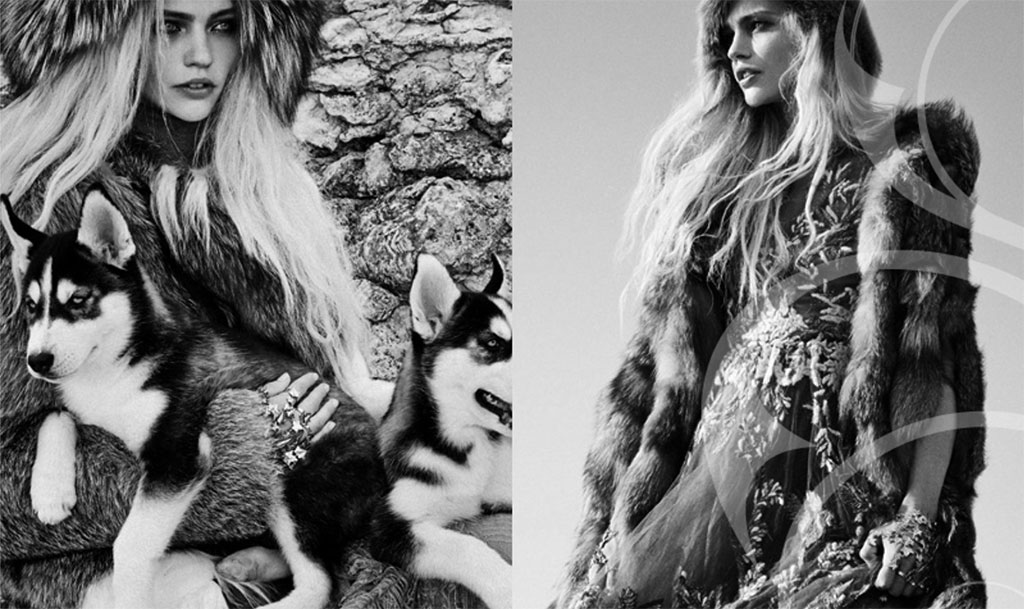
Is fur in or out? Or can it be both at the same time? Photo: Always in Vogue.
Consumers are receiving mixed signals, with some saying fur is back and others saying it’s on its last legs. So does someone have the story wrong? Let’s see where the evidence points.
Compared with the 1980s, when fur sales were strong in all traditional markets, today’s trade has shrunk, a fact it blames on the anti-fur lobby. But it also says fur is making a modest comeback. In contrast, anti-fur campaigners insist the fur trade is terminal.
In our quest for the truth, let’s journey back in time, hoping this will help explain where fur really stands today.
Animal Rights Playbook
The anti-sealing campaign was the start of the modern animal rights movement.
The modern animal rights playbook was written in the 1970s on the blood-stained ice floes of Atlantic Canada. With a cast of cute seal pups and “evil” sealers wielding hakapiks, protesters learned that all they had to do was provoke a fight (think Paul Watson) while Brigitte Bardot added credibility and sex appeal. The media lapped it up, and the campaign was hugely effective.
Another landmark came in 1990 when People for the Ethical Treatment of Animals launched the campaign “I’d rather go naked than wear fur”. Everyone knew that sex sold, but this was the first time animal rights had been conflated with naked women. Again the campaign was a media hit, prompting PETA founder Ingrid Newkirk to tell The New Yorker in 2003: “We are complete press sluts”. (PETA officially “retired” the campaign in 2020, but this was probably just to give media an excuse to run old campaign photos.)
Meanwhile, the fur trade was losing ground. The media (and their viewers) were by now hooked on images of stressed animals and naked women, and the fur trade couldn’t compete. Plus, funds were running low for public relations, and while some people were determined to fight back, they couldn’t agree on how to do this.
New Tactics
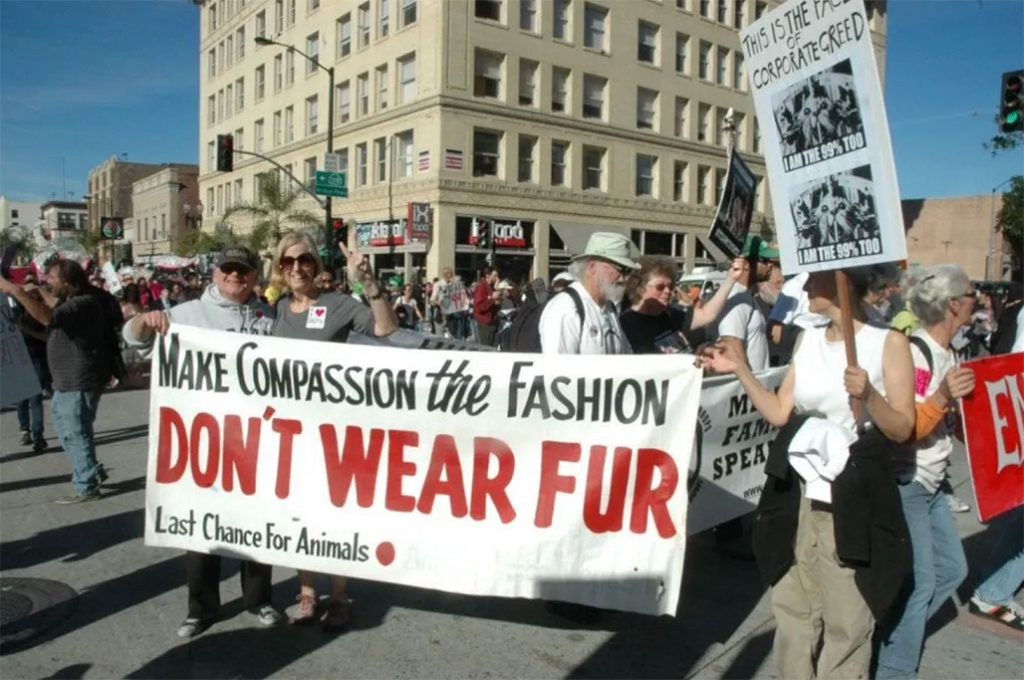
West Hollywood was the first Californian city to ban fur sales. Photo: Last Chance for Animals.
Then the 2000s arrived and the anti-fur lobby expanded its already strong arsenal with some new tactics.
Pushing local fur bans: One tactic has been to push US city governments to ban production and/or sales of fur. The fur trade must then file lawsuits to have ordinances overturned.
Almost all of the anti-fur lobby's victories so far have come in Californian cities, followed by a statewide ban from 2023. Notably absent has been the snowball effect campaigners hoped for in major cities and states elsewhere.
Still, it’s an effective tactic even when ban attempts fail, since it generates media exposure and costs the fur trade money. This has happened in cities where fur is more entrenched, like New York City in 2020, Denver in 2024, and Chicago in 2025.
Pressuring players to switch from real fur to fake: Another tactic has been to get key players to drop real fur in favour of fake, with the anti-fur lobby then taking credit for players “seeing the light”. While a few early converts required little persuasion, most victories have only come about after harassing executives with methods like demonstrating outside workers’ homes. Targets have been diverse, ranging from luxury brands and designers, to department stores, fashion shows and even magazines.
Fur farming bans: Yet another tactic has been to pressure governments to ban fur farming or pass regulations so draconian that it makes no sense to continue.
Though in its third decade, this campaign gained fresh legs during the Covid-19 pandemic as activists stoked fear that mink farms breed zoonotic diseases. This fear was key in the 2020 move by Denmark – then the world's leading mink farmer – to cull its entire herd, and British Columbia’s 2021 decision to phase out mink farming.
This campaign has been especially effective in the European Union, with most members having already introduced partial or total bans, the latest being Poland. Meanwhile, the "Fur Free Europe" citizens' initiative gathered over 1.5 million signatures opposed to fur farming and the sale of farmed products, obliging the European Commission to decide by next March whether to propose an EU-wide ban.
Whether an EU-wide ban happens is still unknown, plus the issue of wild fur will remain on the table. But with some 70% of fur currently coming from farms, and global output contracting steadily, who, if anyone, will pick up the slack?
So kudos to the anti-fur lobby. Though it has often fought dirty, its tactics have undeniably hurt the fur trade.
Plastic Windfall
As Gucci president and CEO in 2017, Marco Bizzarri demonstrated a complete misunderstanding of sustainable use. Photo: Gpautou, CC BY-SA 4.0 via Wikimedia Commons.
But another version of this story has it that fur is making a comeback. If true, it all began with a windfall for the trade: a miscalculation by its opponents.
When the modern animal rights movement emerged in the 1970s, Western society was made keenly aware of animal welfare issues. These remain important today, but have been superseded by existential issues threatening the very future of the planet.
In recent years, society has undergone a sea change, with terms like “sustainability”, “climate change”, “global warming” and “renewable energy” entering everyday usage. And the cause célèbre is how to wean ourselves off fossil fuels like petroleum.
Of course, the fur trade has always known fur is sustainable: it’s durable, biodegradable and renewable, and its environmental footprint is a lot smaller than the anti-fur lobby claims. So logically, society's shift in priorities should benefit real fur, and work against fake fur made of non-renewable, polluting, non-biodegradable, petroleum-based plastics that only add to the tons of microplastics already in our watersheds and oceans.
So what have most anti-fur groups done? Rather than keeping their message simple and opposing all fur, real and fake, they have thrown their support behind fake fur as a replacement for the real deal, falsely claiming it is more sustainable!
This is now backfiring. Not only has fake fur kept the furry look (real or fake) on the fashion radar, it has also exposed the anti-fur lobby as dishonest.
Perhaps the biggest shock for the fur trade came in 2017, when Gucci announced it was dropping real fur. Both the world-famous brand and its animal rights handlers effused about how the move enhanced sustainability, and for a while the fur trade feared society would simply fall for this deception. But now, the media and consumers are at least questioning whether fake fur was the right way to go.
The anti-fur lobby, meanwhile, has attempted damage control, such as by calling plastic garments “vegan clothing”, and promising we'll all be wearing “bio-fur” soon, made of fungi, nettles, pineapple and the like.
Maybe one day we will. But for now, almost all manufacturers of fake fur still prefer the petrochemical kind, so the harm it does to the environment continues.
Recycled Vintage Fur
Outside London Fashion Week, wearing fur is fine, but inside is a different story. Photo: garryknight, CC BY 2.0, via Wikimedia Commons.
Then, to confuse matters further, along came vintage fur.
As any fashionista knows, recycled and remodeled vintage furs have been in vogue for a few seasons. Many come from thrift stores and are at least 40 years old, though with demand still strong, it's inevitable that dwindling supplies are seeing ages fall.
For an example of just how vintage furs have confused the picture, look at media coverage last February of the New York and London Fashion Weeks.
Hoping as always for a new angle, on Feb. 16 the New York Times ran a piece titled “What happened to the stigma of wearing fur?” “[I]n January,” wrote Jessica Iredale, “women and men all over town were busting their furs out of storage in what felt like an abrupt reversal of social values.” For years, wearing fur in the US and Europe had felt taboo. “Except, suddenly, people don’t seem to care – especially if the wearer can assert the mantle of ‘vintage’, as no animals were freshly killed and upcycling old clothes is more virtuous than buying new.”
The irony was that last December, New York Fashion Week announced a ban on fur from 2026!
Even more ironic was a report in The Standard (Feb. 21) during London Fashion Week titled “How luxury fell back in love with real fur and crocodile skins”. It was commenting on the street scene rather than on the show’s runways, because it couldn’t do otherwise. London Fashion Week had already banned fur, in 2023, followed the next year by exotic skins and feathers!
What message were these reports sending to consumers?
Was the real story not about vintage furs, but about the resurgence of fur in general? Were the likes of New York and London Fashion Weeks just part of an ivory tower trying to move past fur, while the streets said the opposite?
Predictions
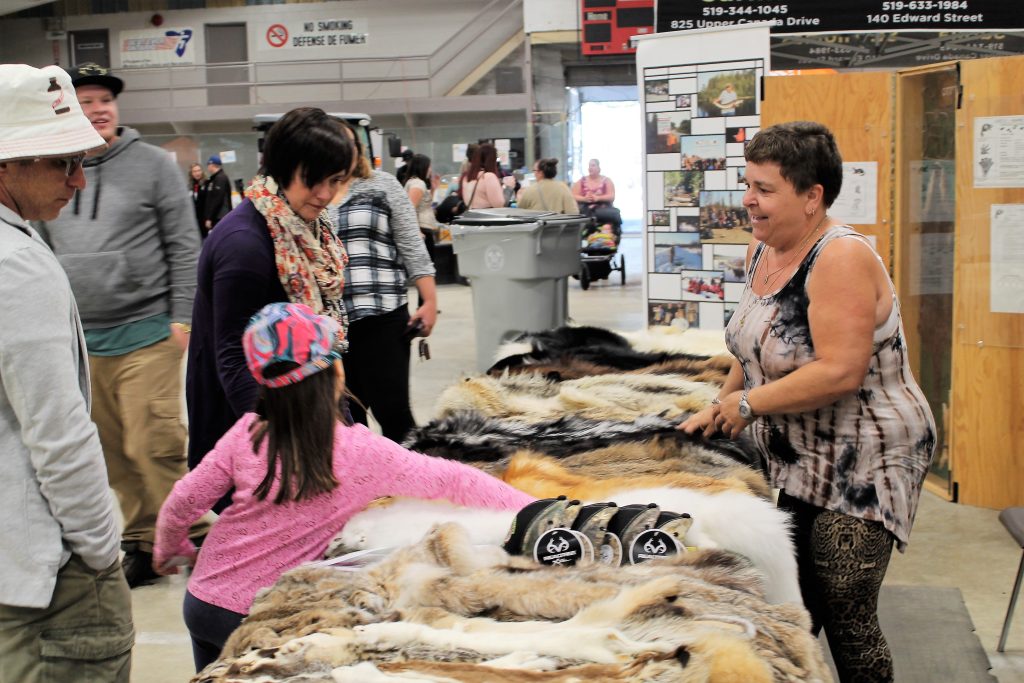
If there is a shortage of farmed fur, sales of wild fur are likely to increase. Photo: Timmins Fur Council.
So where does this leave the fur trade today?
Let's first agree who we’re talking about. I'll call it the Western fur trade, that caters primarily to certain consumers in two regions: North America and Europe, and an East Asian bloc, centering on China and South Korea, that buys a lot of pelts at Western auctions and has designers showing on Western runways. Millions of fur users, especially Indigenous peoples in the High North, don't belong in this category, and won't stop using fur just because of a few bans passed in Western capitals.
That said, the Western fur trade has been under attack for decades, giving the anti-fur lobby plenty of time to refine some highly effective tactics.
No one will deny that these tactics have hurt the fur trade, but many believe the trade has now turned a corner to recovery. Assuming this is true, how durable that recovery is depends on the trade's ability to change.
One change that may be unavoidable is a fall in total output of farmed fur, plus a shift in suppliers. When shortages seemed likely in the past, North American, European and (in this century) Chinese farms simply increased production. But this time around will be different.
Obviously, EU production is falling and may stop entirely, but it's also down in North America due to bad publicity from the anti-fur lobby, and no one is expanding right now. So unless Chinese farmers step up again, or another country fills the breach, a supply shortage could be looming that requires the fur trade to operate at a reduced scale.
There are, however, a few avenues that are already expanding.
One is sales of wild fur. Pelt prices are edging up for some species; for example, at Fur Harvesters Auction last month, interest was strong in bobcats, marten and wild mink. Also, the number of trappers is increasing in many places. And since trapping is now widely recognised as an important conservation tool, choosing wild fur is one way consumers can show their support for sustainable use. There is still opposition to trapping where wildlife and human habitats coincide, notably among dog walkers, but also on the rise are problem animals like coyotes with mange, rabid raccoons and destructive beavers, so trapping won't disappear anytime soon.
Other avenues for expansion are better opportunities for artisanal designers and online retailers, especially in remote areas. Factors fueling this growth include the departure of most luxury brands and department stores from the real fur market, the closure of many brick-and-mortar furriers in expensive downtown locations, and of course the rise of the Internet, which makes it possible to run businesses in remote locations that were not viable before.
Whether all this translates into a comeback for fur remains to be seen, but the signs so far are promising. For now, there's a paradox: on the one hand, the anti-fur lobby continues its efforts to end the fur trade, with a lot of success. But on the other, many media reports and eye-witness accounts say fur is back in fashion. Who is right? Only time will tell for sure.
The news about fur is so muddled these days, it’s no wonder some people are confused. Take the surging popularity… Read More
Politically-correct designers say shearling is not fur at all! Photo: HiSO.
The news about fur is so muddled these days, it’s no wonder some people are confused.
Take the surging popularity of used furs. As we reported recently, GenZ is embracing “vintage” as a guilt-free way to enjoy the comfort and beauty of fur. After all, the animals died long ago, and reusing old clothing is better for the planet than contributing to mountains of discarded – usually petroleum-based – fast fashion. Fine, but why stop there? After all, today’s new furs will be tomorrow’s vintage.
Similarly, shearling is trending on fashion runways, with politically-correct designers claiming it is not fur at all. But isn’t it? Shearling is an animal hide (sheepskin) processed with the hair attached, the same as any other fur. Some find it reassuring that sheep are raised for food, that my shearling jacket is just the packaging from someone’s rack of lamb – a distinction that probably wouldn’t impress sheep. In any case, Indigenous and other trappers eat beaver, muskrat, seal, and other fur animals. What’s the difference?
Meanwhile, anti-fur campaigning continues: governments are lobbied to ban fur production; many apparel companies have stopped selling it; and Vogue – following the retirement of their dauntlessly independent editor, Anna Wintour – recently announced that fur will no longer appear in the magazine, even in advertising.
So, is fur back in fashion, or isn’t it? Why is sheepskin now cool, but mink and beaver not so much? And how does fur become more ethical with age, or is it just the lower price point that draws young people to “vintage”?
Quite the muddle.
Why All the Fuss About Fur?
Of course, there’s nothing new in muddled thinking about fur. Animal activists have spent decades tarring fur trapping as cruel – even as millions were invested by governments and industry to assure the humaneness of trapping.1
Activists also denounce mink farming, claiming that it’s cruel to keep “wild animals” in pens. But mink have been raised on farms in North America since the 1870s. After more than 150 generations of selective breeding they are very different than their wild cousins – they are twice the size, much tamer, and well adapted to life on the farm.2
The fur trade is not a rogue industry, it has adopted responsible practices just like other agricultural sectors. From an animal-welfare perspective, it sometimes scores better: wild furbearers roam freely in nature until the moment they’re captured; farmed mink – precisely because they are not used for food – are spared the long truck ride to distant abattoirs. And yet, in a society where literally billions of animals are eaten each year, the fur trade has been treated as a pariah. Go figure.
Sustainability
Animal rights groups provide a cover for petroleum-based synthetics that are anything but sustainable. Photo: Genghiskhanviet.
Another example of muddled thinking is the belief that we should stop using fur if we wish to protect nature. When Gucci CEO Marco Bizzarri announced that his prestigious designer label would go “fur-free”, in 2018, he claimed this demonstrated “our absolute commitment to making sustainability an intrinsic part of our business.” Other companies followed suit, revealing how little they understood (or cared?) about what sustainability really means.
Many wild species are indeed threatened by climate change, pollution, urban sprawl, and other challenges. Some fear we are witnessing a “Sixth Mass Extinction”. But the modern fur trade does not deplete wildlife populations; the fur we use today comes from abundant populations. Government regulations ensure that only part of the surplus that nature produces is taken each year – which is true sustainability. This is why Greenpeace, the Worldwide Fund for Nature (WWF), the International Union for Conservation of Nature (IUCN) and other serious environmental conservation groups do not oppose the fur trade. The North American fur trade is a conservation success story that deserves to be better known.
And so, anti-fur campaigners – and companies that yield to their pressure – are not promoting sustainability at all. Quite the contrary: because “animal rights” groups oppose using any animal products – no fur, no leather, no wool, not even silk -- they provide cover for petroleum-based synthetics that are not renewable or biodegradable, that leach micro-plastics into the environment each time they are worn or washed – but are now often marketed as virtuously “vegan”.
The Medium Is the Message
For many of today's children raised in cities, cartoons define their fantasies of nature.
Confusion about fur is not accidental. Animal-rights advocates are not interested in acknowledging the animal-welfare and conservation achievements of the fur trade because they oppose any use of animals. As PeTA’s website clearly asserts: “Animals are not ours to experiment on, eat, wear, use for entertainment, or abuse in any other way.” But because few people are prepared to follow PeTA to such lofty heights of moral purity – only 4% of North Americans are vegetarian; barely 1% say they are vegan – attacks on fur (and other animal-based industries) are disguised as animal-welfare campaigns, sensationalizing real or purported abuses.
Industry efforts to correct misinformation face the problem that, in an age of information overload, attention spans are limited, especially for subjects remote from most people’s daily lives. One gory photo trumps volumes of expert testimony.
Meanwhile, to retain fickle audiences, the media are drawn to controversy and confrontation. Trappers and mink farmers diligently tending their traplines or barns are not news; a dozen shouting protesters make better television – especially if some are topless. “We’re media sluts,” says PeTA co-founder Ingrid Newkirk. “We didn’t make the rules but we learned to play the game.”
The game is also rIgged demographically. Not so long ago, most North Americans still had family living on farms; summer vacations provided hands-on education about where food comes from – and respect for the skills and knowledge of people who fish, hunt, and raise livestock.
Now, for the first time in human history, most of us live in cities, with little or no contact with the land. Children are raised on Disney fantasies of nature, where the lion frolics with the lamb. The animals we frequent are mostly our pets, which increasingly are treated as “children”. Often, they sleep in our beds. When the only canine you know is your dog, it is easy to be upset by images of coyote trapping or fox farming – especially when the images are carefully selected to shock.
Fur is denounced as an “unnecessary luxury”, catering to spoiled rich people. But, despite its luxury image, the fur trade remains small-scale and artisanal; it lacks the financial and other resources that larger industries can deploy in response to misleading activist campaigns.
Protection Racket
Confusion is also caused when anti-fur campaigns become self-reinforcing feedback loops. When Canada Goose and other prominent apparel brands stop using fur, it suggests that something must be wrong with it; people must no longer want it. But the real reasons why companies drop fur have little to do with ethics or consumer demand. Store invasions, rowdy protests at the homes of CEOs, social media attacks, and other aggressive tactics simply make fur too hot to handle. When security and brand-reputation costs for a small segment of a company’s sales become too great, dropping fur is a business decision.
Consumers could also be bullied – especially because most were women. (A leading animal-rights theorist once told me he thought PeTA would show more integrity if they protested biker gangs for wearing leather jackets!) Many women stopped wearing fur, not because they thought it was wrong but for fear of having paint thrown at them. Ethics, indeed!
The Future of Fur
From an environmental perspective, fur is not a “frivolous luxury”. Photos: Benzing Charlebois.
So where do all these mixed messages leave us? Is the recent popularity of vintage fur and shearlings just a fashion blip, or the beginning of a real shift in the tectonic plates of social consciousness?
One encouraging sign: despite decades of negative publicity, most people have a more positive view of fur than animal activists would have us believe. An opinion poll commissioned by the Natural Fibers Alliance, in 2022, found that two-thirds (65%) of Canadians think wearing fur is acceptable so long as the industry is well regulated and animals are treated humanely. Only one-in-five (21%) disagrees – with just 10% saying they “strongly disagree”.
In the US, same story: 61% agree that brands and retailers can responsibly use and sell animal-based products including leather, wool, silk, and fur. Only 9% strongly disagree.3
More than three-quarters (77%) of Canadians also believe that wearing fur is “a matter of personal choice” – similar to findings in previous US studies – putting the lie to activist claims that the public supports their call for the governments to ban fur farms and retail fur sales.
Especially interesting: for the first time in the 25 years that I have reviewed such surveys, younger people (18-25) now see fur in a more positive light than their elders. GenZ’s love affair with fur is not a fluke.
People are becoming more aware of the environmental costs of non-biodegradable, petroleum-based “fast fashion” – not to mention concerns about the leaching of micro plastics into the food chain each time these synthetics are worn or washed. Bits of plastic are now being found in marine life, breast milk, and in our brains. Cruelty-free indeed.
Bottom line: people do need clothing, and if our goal is to embrace more sustainable lifestyles, fur checks all the boxes. Made from a natural, renewable resource, fur apparel is extremely long-wearing, can be re-styled as fashions change, and is often passed from one generation to the next – as highlighted by the current popularity of vintage. From an environmental perspective, fur is not a “frivolous luxury”.
From a cultural perspective, the fur trade preserves a treasure-trove of human knowledge, skills, and culture. Indigenous and other trappers are some of the last representatives of our hunter-gatherer heritage; with most of us now living in cities, they are our eyes and ears on the land, often the first to sound the alarm when pollution or habitat destruction threaten wildlife. Mink are raised on multi-generational family farms, providing income and employment for embattled rural communities. Fur artisans (my own grandfather was one) maintain extraordinary handcraft skills that have been transmitted through generations.
None of this means that everyone will want to wear fur. But the popularity of vintage furs and shearlings bucks the – until recently – seemingly irresistible push to “cancel” the fur trade. As Leonard Cohen sang: “There’s a crack, a crack in everything, that’s how the light gets in!” Time will tell whether GenZ’s new interest in fur will open the door to a more honest appreciation of this remarkable North American heritage industry.
FOOTNOTES
1) The program directed by the Fur Institute of Canada (since 1983) allows new trap designs to be rigorously tested and certified. It has supported new state and provincial regulations, trapper training programs, and, in 1997, the Agreement on International Humane Trapping Standards (AIHTS) – the world’s first international animal-welfare treaty. See also: Neal Jotham: A life dedicated to humane trapping. Truth About Fur, 2016.
2) Mink housing, nutrition, and care standards are set out in codes of practice developed by animal scientists and veterinarians, under the auspices of the National Animal Care Council.
3) Natural Fibers Alliance, personal communication.
A flurry of media stories last Winter announced, with evident surprise, the sudden reappearance of fur on designer runways and… Read More
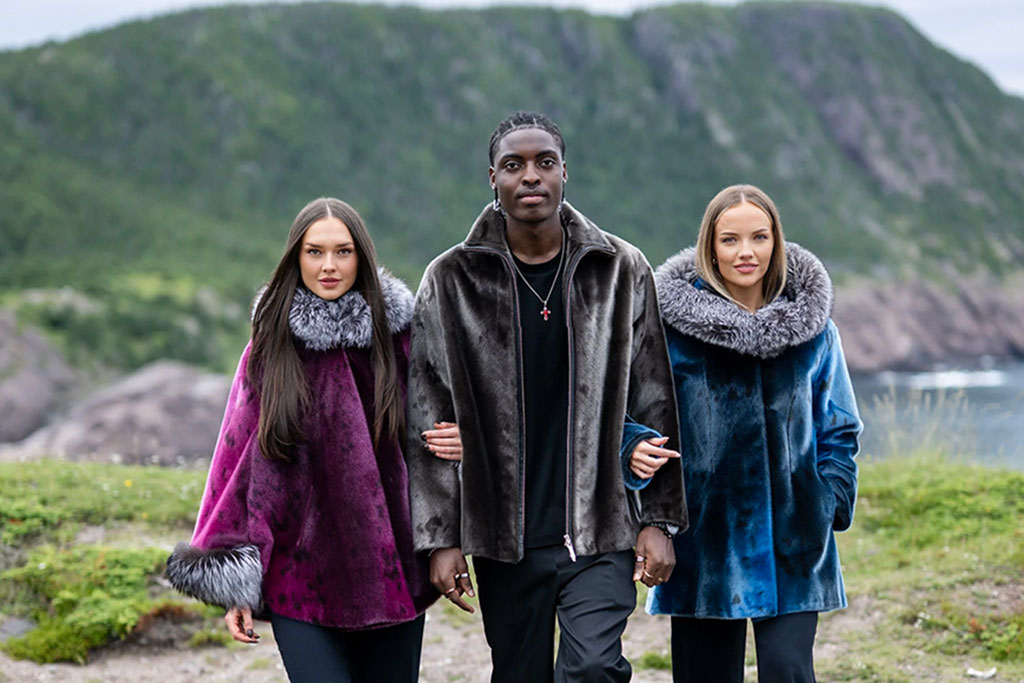
This modern bomber jacket could not be less like her grandma's full-length mink. Photo: Fourrures Léopold Martel.
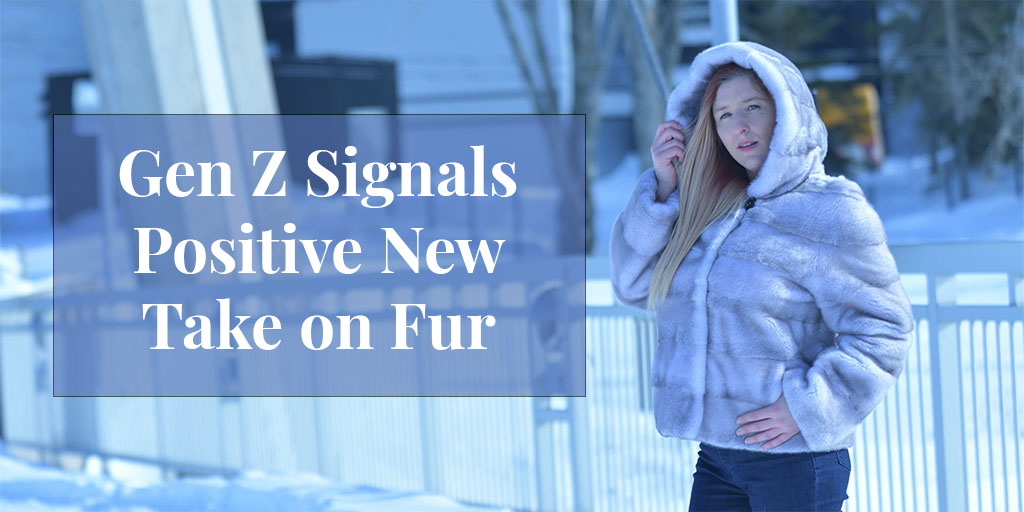
A flurry of media stories last Winter announced, with evident surprise, the sudden reappearance of fur on designer runways and in the streets, with Gen Z consumers leading the way. Could the fashion pendulum really be swinging so far? Are new opportunities really opening for those in a trade that has suffered from years of unfair and misleading anti-fur campaigning?
The New York Times (Feb. 16) led the pack with a piece entitled "What happened to the stigma of wearing fur?” "[I]n January," it observed, "women and men all over town were busting their furs out of storage in what felt like an abrupt reversal of social values.” For years, journalist Jessica Iredale wrote, wearing fur in the US and Europe had felt taboo. “Except, suddenly, people don’t seem to care – especially if the wearer can assert the mantle of ‘vintage’, as no animals were freshly killed and upcycling old clothes is more virtuous than buying new.”
The stories just kept on coming. On Feb. 28, Women’s Wear Daily featured lamb shearling on its cover, declaring that “Furry textures – some real, some faux” were all over the runways at New York Fashion Week. “Welcome to the latest downtown uniform as a new generation looks at fur a different way.”
It was the same across the pond. On Feb. 21, for example, The Standard of London reported "How luxury fell back in love with real fur and crocodile skins". “Despite the bans and the rise of faux fur, it looks like fashion is falling in love with the real thing again,” declared journalist Rebecca Cope. Pip Chawner, whose brand Philippa London repurposes vintage fur, agreed: “If you walk up and down King’s Road, pretty much every fifth person is wearing a piece of fur.”
Fur was also prominent at the Paris and Milan fashion weeks, at upmarket Aspen and St. Moritz ski resorts, and on celebrities including Rihanna and Kendall Jenner.
So, what did happen to the stigma of wearing fur, as the New York Times asked? Or perhaps, for someone like me who has spent much of the past 40 years defending this much-maligned North American heritage industry, a better question would be: “What took so long?” But I am getting ahead of myself.
A fox vest (left) will keep Gen Zers warm on most days, but if it's sub-zero outside, this coyote coat will do the trick. Photo: Morris Furs.
Until recently, promoters of fake fur – or "faux" fur, as they call it – insisted that the main reason for choosing it over the real thing was that it was “cruelty-free”.
But there is growing awareness that fake fur, like most synthetic textiles that now account for some 60% of our clothing, is made from petroleum. As such, it doesn't biodegrade, and it sheds clouds of microplastics each time it’s washed or worn. These tiny pieces of plastic are now being found in marine life, and even in breast milk. Cruelty-free, indeed!
As trend forecaster Tiffany Hill, interviewed by The Standard, put it: “Some consumers are questioning whether banning fur was truly an environmental win, given the environmental impact of synthetic alternatives. As concerns over fast fashion and microplastic pollution grow, some argue that natural fur – when sourced responsibly – is actually a more sustainable option.”
Sweet words indeed!
Shearlings and Vintage
Fur lends itself to looking chic – another draw for Gen Zers. Skiing anyone? Photo: Mitchie's Matchings.
But the fight is not over yet. While fur is creeping back into the fashion limelight, decades of anti-fur campaigning have left their mark. The confusion these campaigns have caused can be seen in the way fur is now being embraced with claims that vintage fur is more virtuous than new, and that shearling is not really fur at all!
As any fashionista knows, vintage furs have been a huge hit for the past few years, and their appeal is obvious. As designer Carly Mark spelled out in the New York Times, the draw of vintage fur is that “it already exists”.
Rebecca Cope of The Standard agrees. “Gen Z have embraced fur more wholeheartedly than other generations for a specific reason – it can be argued that vintage fur is entirely sustainable, while the majority of faux fur alternatives are not, due to the plastic content.”
In other words, vintage fur satisfies the ecologists’ call to reduce the enormous waste generated by disposable “fast fashion”. The next step, of course, will be to recognize that the same arguments support using new furs too: A quality fur coat can be worn for decades, and can even be taken apart and completely restyled as fashions change – an important environmental advantage.
A long-term problem with vintage furs, obviously, is that supplies will run out if folks stop buying new furs. On the plus side, vintage gets unused older furs out of the storage vaults and onto the streets, to remind people of the warmth and beauty of this remarkable natural material.
The renewed popularity of shearling is another example of how fashionistas are rationalizing their return to fur ... by pretending that it isn’t fur at all!
“Well, it’s shearling, not fur,” said Matteo Tamburini, creative director of Italian fashion house Tod’s, in Vanessa Friedman's New York Times report from Milan Fashion Week (Mar. 2). “It’s all shearling,” echoed Maximilian Davis, creative director of Ferragamo. “Fur is something we can’t use today, we shouldn’t use today ...”
Shearling definitely is fur, of course, just like mink or fox or any other fur: they are all animal skins tanned (dressed) with the fur (wool, hair) still attached. Shearling, however, comes with the handy moral buffer that it’s just left-over packaging from someone’s rack-of-lamb.
This by-product-of-food-production argument doesn’t cut it with animal-rights groups, since PeTA et al. also want to “cancel” the use of animals for food. But few people seem ready to follow PeTA’s call to such heights of ethical purity. A recent Gallup poll found that only 4% of Americans now say they are vegetarian (no meat in their diet), while just 1% identify as vegan (no dairy, eggs, or other animal products).
Perhaps it’s time for furriers to promote the “food-by-product” story to beaver, muskrat, sealskin, and other fur animals which are also eaten?!
Is it time to remind consumers that sealskin is also a by-product of food production for Arctic and coastal peoples? Photo: Always in Vogue.
For those of us who have tried for years, often with little success, to explain the fur trade’s ecological credentials, it is music to our ears to read in a prominent newspaper that, "Some consumers are questioning whether banning fur was truly an environmental win, given the environmental impact of synthetic alternatives."
For too long, facts were no match for sexy photos of celebrities who would “rather go naked than wear fur”.
But now we may be at a turning point. Just when it looked like fur was headed for the dustbin of history, the tectonic plates of societal consciousness have shifted again.
Of course there are still serious obstacles to overcome. For example, anti-fur activists continue to call for bans on fur production and sales in many regions, and prominent fashion media like Vogue are refusing to cover fur fashion or even accept advertisements.
But younger consumers are clearly ready to look at fur differently.
It’s now up to the fur trade to take advantage of this new openness to promote the comfort, beauty, and, yes, the environmental and ethical credentials of this remarkable heritage industry.
This is the story of just one students’ club in British Columbia, with a trapping component, that could use a… Read More
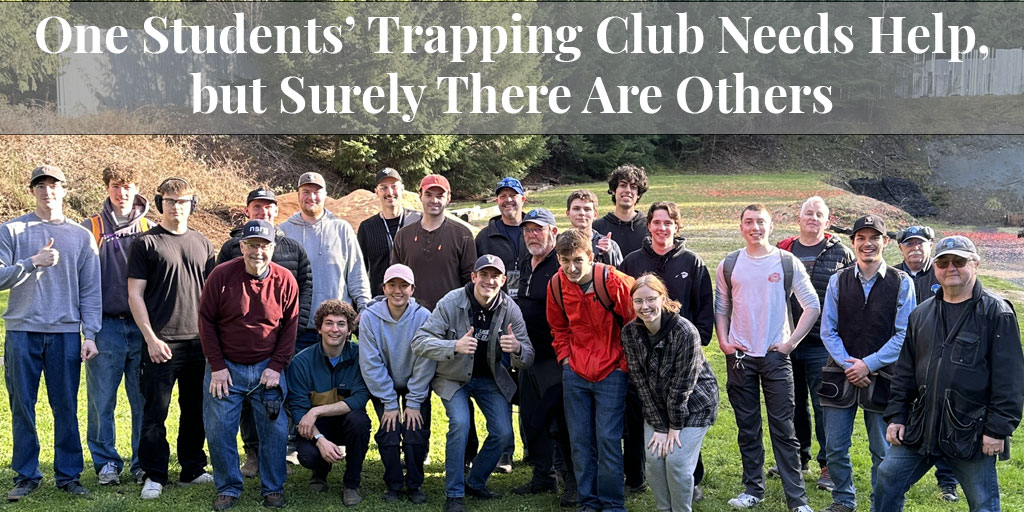
This is the story of just one students' club in British Columbia, with a trapping component, that could use a helping hand. But hopefully it will also open eyes across Canada. You probably live far from BC, but maybe there's a trapping club nearby that faces similar problems. Can you help? Or maybe you're struggling to start your own trapping club, and can learn from this young man's experiences.
Meet Cole Mark, a 25-year-old born in BC's capital, Victoria, and a student at the University of Victoria, or "UVic" to those in the know.
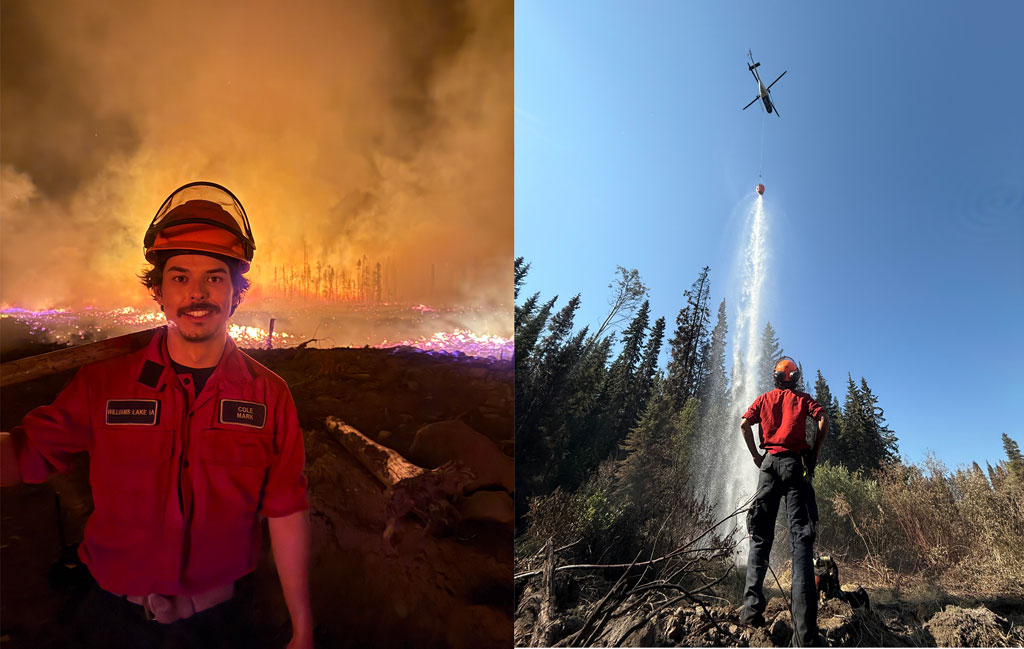
By anyone's definition, Cole is an outdoorsman. When he is not studying forest biology or working for the BC Wildfire Service, he is hunting, rock climbing, backcountry skiing, fishing, scuba diving, spearfishing, shooting (guns and bows), and foraging. He also has "strong passions" for wildlife management and sourcing his own food.
It was in character, then, that in 2023 he started the UVic Freediving and Spearfishing Club, and followed this up in 2024 with the UVic Fish and Game Club – the one we're going to talk about today.
As the name suggests, the UVic Fish and Game Club dabbles in a wide range of activities, both hands-on and involving educational presentations and licensing courses. One of the most successful components has been shooting, with nearly 50 members completing their firearm safety training in the club's first semester alone.
The trapping component, however, is proving more challenging to get off the ground – something we'll circle back to.
Making of an Outdoorsman
Cole keeps himself busy! When he's not studying or running two clubs, he's working as a firefighter.
Truth About Fur: In your own words, Victoria "offers limited exposure" to outdoor activities, while your parents are a teacher and a lawyer. How, then, did you become an outdoorsman?
Cole Mark: My love of nature was largely instilled in me by my late grandfather and my uncle. My grandfather and I spent days fishing, and he shared stories about hunting and fishing. My uncle, a commercial diving captain, often took me fishing and crabbing, further shaping my passion for the ocean and outdoors.
Ironically, as for Victoria, the capital of BC, its limited offering of exposure is largely because of considerable social pressure to oust these foundational pieces of Canadian tradition and heritage. This makes it awfully intimidating for people to take interest in, never mind trying to be a part of, outdoor recreation.
As many of you know, and starting well before I was born, there was a slow clawing at everything trapping, hunting, fishing and shooting. However, today it's been turned into more of a cutting away. As a young man who cares deeply about his country, neighbour, and having a family of his own one day; I quickly realized that I needed to be the change I wanted to see. I knew it wasn’t going to easy. The idea alone of starting a fish and game club that promotes the education of firearms and trapping at the University of Victoria was completely nuts. And it has been a wild ride for me to say the least. But, I knew I needed to make a difference where I could. I understand how intimidating these pursuits can seem to people with no background in them, and this is what drives me to make outdoor education more accessible. I want others to discover and appreciate this important part of Canadian tradition, heritage and culture.
TAF: Starting the Freediving and Spearfishing Club and then the Fish and Game Club was a logical step for you, then?
CM: That's right. The mission of both clubs is to provide a space where students can develop practical skills, build a deeper connection with nature and food, and promote safety, ethics, and conservation in all activities with friends and without worrying about backlash. Both clubs have been incredibly rewarding to start and run, and they have taught me a lot about leadership, community building, and sharing my passion with others.
TAF: Could society do with more such clubs?
CM: I certainly believe so, especially at the university level. I keep my club entirely apolitical. My goal is to give anyone an experience and working knowledge so they can make informed opinions from choosing whether or not to buy a fishing rod at a local store, getting a firearms license (restricted or not), or casting a ballot.
Additionally, many of the outdoor recreational activities that fish-and-game clubs foster, including trapping, are being phased out in my generation. And as they disappear, we are also losing the heritage, values and most importantly the virtues they bring and inherently teach.
Our UVic club also just had our first hunting event approved! This event utilized an initiation hunting license where any student could get a license and hunt for the first time with a licensed student. It must be the first hunting trip a university club in BC, or maybe even in Canada, has done in decades.
TAF: You have no background in trapping, and yet your club offers this skill. How did this come about?
CM: I acquired my trapping license in 2021. I can thank Mr. Steven Rinella and a few whispers of stories about trapping here on the island for developing my interest. Ever since, it's been a defining part of my development as an outdoorsman and as a young academic. It has taught me lessons that my degree could not, from hands-on wildlife management and land stewardship to the practicalities of renewable resource management. It has taught me that there is a gap in understanding the vital role that trapping plays in sustainable wildlife management, land stewardship, and in renewable resources. It has instilled in me a profound respect for the delicate balance of ecosystems, the patience to observe and understand animal behaviour, and the discipline required to work ethically within nature’s cycles. And it has reinforced the values of responsibility, resilience, and humility, showing me that a true connection with the outdoors is not all from theory but also time spent in the bush.
These are the lessons I hope to pass on to my fellow club members.
Hurdles to Trapping
Many thanks to veteran trapper Jerry Baker for helping pass on skills to a new generation.
TAF: You say that two hurdles stand in the way of really getting trapping off the ground at your club: cost and limited opportunities to "get out".
CM: That's right. Overall, the club is doing well. We currently have around 130 members, and our numbers continue to grow as more students seek outdoor experiences and opportunities to learn. Of all the activities we offer, though, trapping presents unique challenges.
There's a decent amount of interest in trapping at UVic, but we need to provide more opportunities for club members to spend time on actual traplines, and we also need to provide a way for them to become licensed. Both face issues of accessibility and cost.
In BC, you can only trap on traplines or on private property. Traplines that were once hundreds of dollars, are now tens of thousands. BC only has around 1,800 licensed trappers, which is roughly a 40% decrease from the 1950’s. I fear what kind of future my own children will face. Will the lifestyle be reserved for a select few diehards and those willing to endure unnecessary scrutiny, criticism, and death threats? I sure hope not.
As for helping students obtain their trapping licenses, so far about 30 students have expressed interest in taking a course, but only one has done so. This was through the British Columbia Trappers Association. Courses cost around $800, are a two-hour drive from town, and only run once a year. So we've been working with the BCTA to offer a more accessible and affordable alternative for club members, but it's a work in progress.
The pride in passing on, and receiving, knowledge is plain to see.
TAF: So have you been able to offer members any opportunities at all to gain hands-on trapping experience?
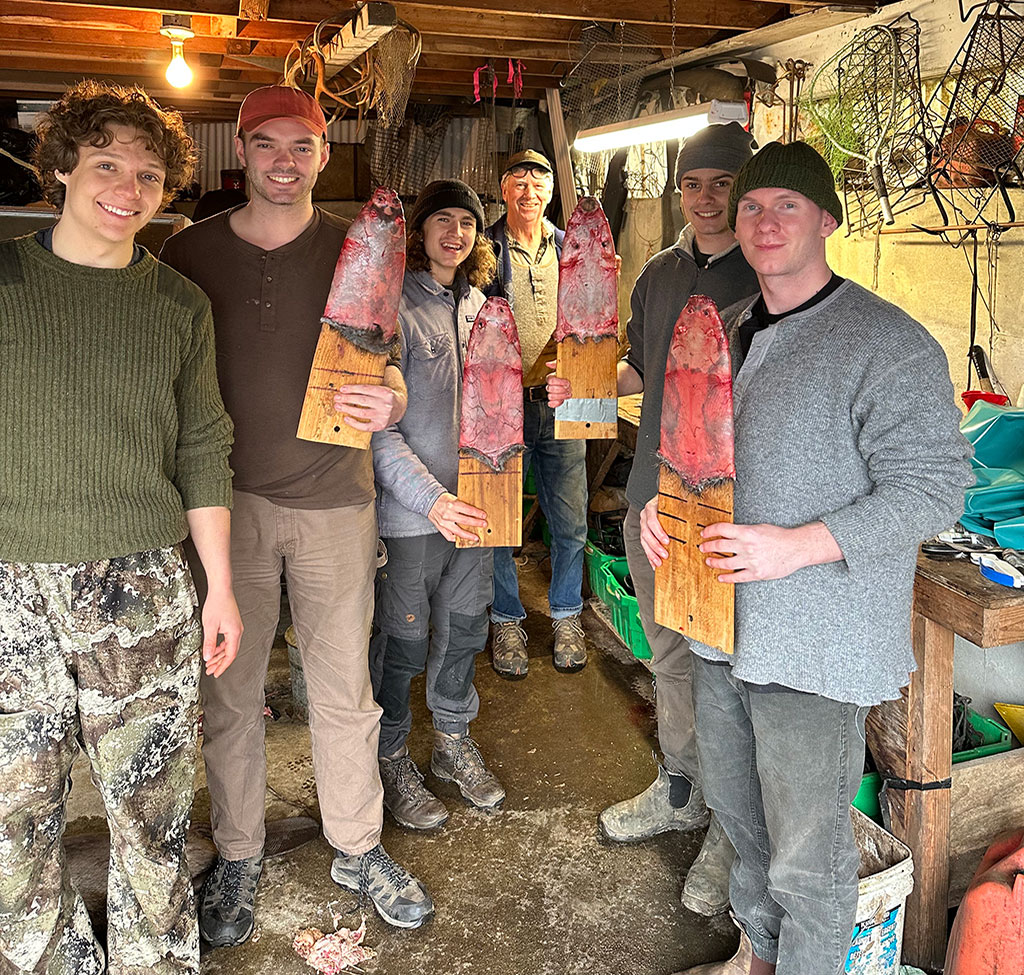
CM: Thankfully, yes. A very generous local trapper and former instructor, Jerry Baker, agreed to host a workshop for just $30 per student! Unfortunately, he will be selling his line soon as he is unable to work it any longer due to age, so we're still looking for a long-term solution. I have had one trapper reach out to us about a line that's pretty close to UVic, however, they’re looking for ~$25,000 which is well more than I have.
My hope is to arrange a partnership or access agreement with a trapper or landowner here on Southern Vancouver Island. My vision is to secure a trapline that the club can use for education, mentorship, and hands-on learning. We have limited funding but I am more than happy to work on something that is mutually beneficial.
I also believe that having guaranteed access to a trapline could offer students unique research opportunities on local furbearing species, and provide new perspectives on how trapping can play a more active role in modern coservation efforts as a wildlife management tool.
Succession Plan
TAF: You'll be graduating from the University of Victoria soon. Do you have a succession plan to make sure the UVic Fish and Game Club continues once you've gone?
CM: I plan to continue my education in forest biology after graduating, with the goal of earning my Registered Professional Biologist (R.P. Bio) and Registered Professional Forester (RPF) accreditations. So I may not be leaving Victoria just yet. But as you say, I must ensure the club has been set up for long-term success, enabling it to thrive as a permanent part of student life at UVic.
To this end, we have a vice-president and an executive team to make sure our leadership succession is smooth and the club has capable hands to carry it forward.
I am also in talks with department heads (Program Coordinator and Dean of EPHE) to explore the possibility of making the club a funded program here at the university. This process is complex and takes time, but if successful, it will give the club access to stable funding and administrative support, which will go a long way toward ensuring its sustainability long beyond my own time here. It also sets a provincial precedent; in BC, there are no institutionally recognized Fish and Game or Shooting Clubs.
Meanwhile, we are gathering every bit of support we can, from organizations, sponsors, and individuals, because not only do we have very minimal funding but these also strengthen our application and demonstrate the value of what we are doing. I am proud to say that we have already received support from the BC Wildlife Federation, Safari Club International, Belisle Traps, the Bass Pro Shops and Cabela's Outdoor Fund, and the Canadian Coalition for Firearm Rights. If you’re interested in seeing more you can check our Instagram page or email us at [email protected].
TAF: We wish you every success, and who knows, maybe your future partner on Southern Vancouver Island – be it a landowner or trapline operator – is actually reading this interview! And as we said in the introduction, it's almost certain that similar initiatives exist across Canada that need a helping hand. Could that helping hand be yours?
In 1997, the Fur Institute of Canada’s Aboriginal Communications Committee launched the Jim Bourque Award in honour of a man… Read More
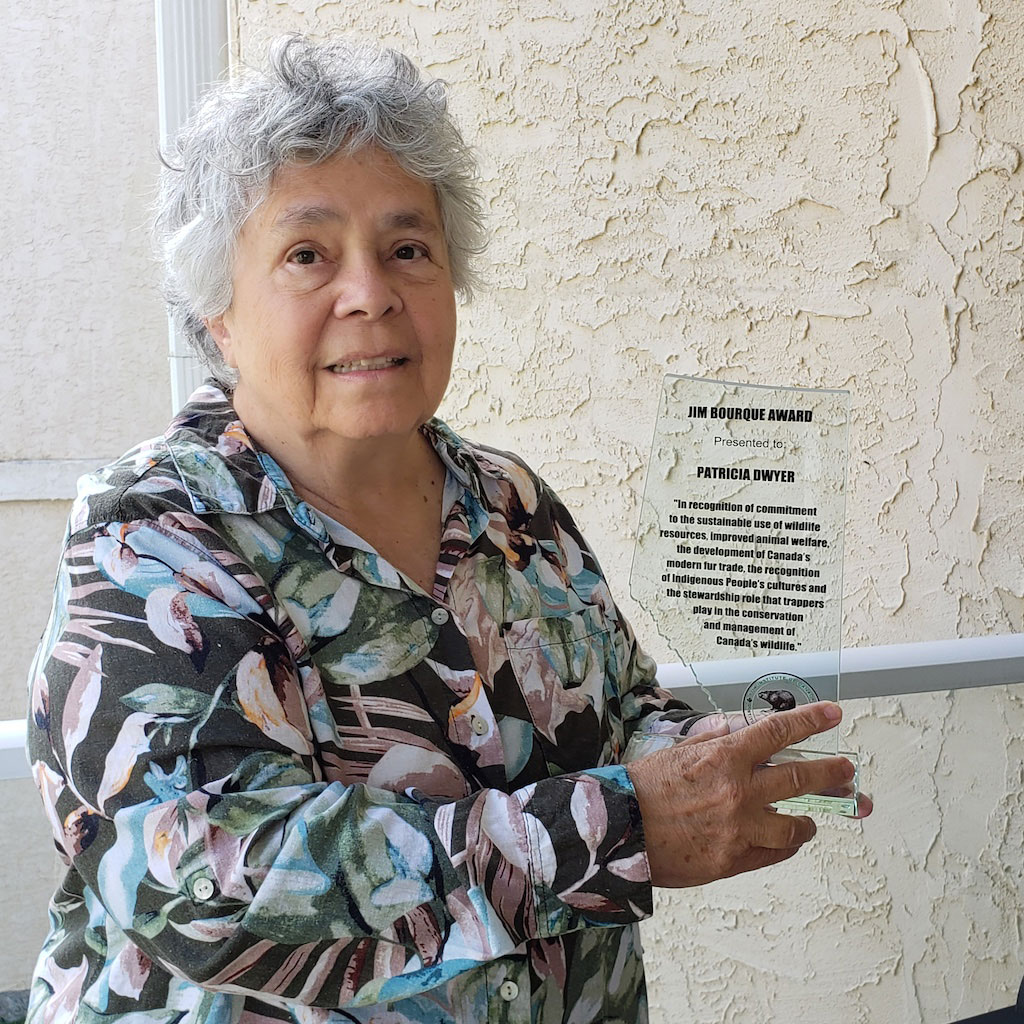
In 1997, the Fur Institute of Canada’s Aboriginal Communications Committee launched the Jim Bourque Award in honour of a man committed to the sustainable use of wildlife, animal welfare, development of Canada’s modern fur trade, and recognition of Indigenous People’s role in the conservation and management of wildlife. This year's award went to Patricia Dwyer, a Métis resident of northern Alberta and director of the Canadian Wildlife Federation. Here is her story.
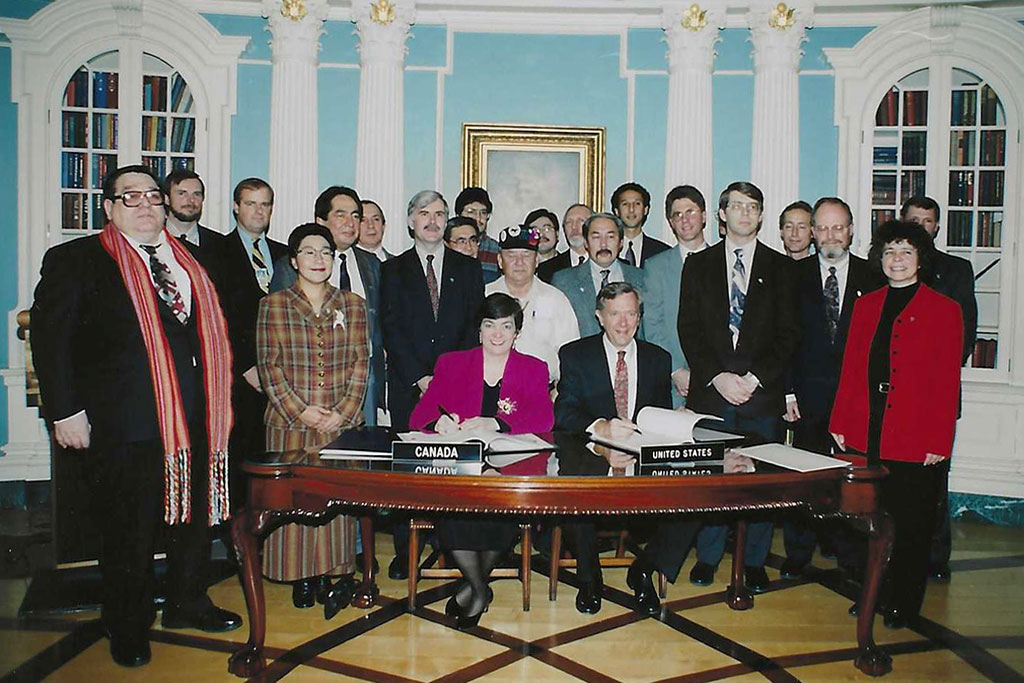
Jim Bourque (far left) and I (far right) were part of the Canadian negotiating team for the signing of the Protocol amending the Migratory Birds Convention, Washington D.C., 1997.
The first traces of my passion for wildlife etched themselves into my mind long before I could spell “conservation.” As a child in northern Alberta, I would explore outdoors with my brother and my cousin. The skies held a fascination of large and small birds, some quiet voices and some joining each other in raucous laughter, while the fields and forest floors provided small mammals like squirrels, skunks, rabbits and porcupines. Occasionally a mink or an otter would be spotted down by the Burnt River. Deer and coyotes were plentiful.
I wanted to be a veterinarian working with wildlife. I never got there, but found other ways to fulfill my passion. I was the granddaughter of a Hudson’s Bay factor and an Indigenous woman who lived in a town of about 300 people and relied on the fruits of nature. After living up there for my early formative years it was no surprise to my parents that I would choose an occupation along that path.
Personal Growth: Lessons Beyond the Curriculum
While studying wildlife biology and management at the University of Guelph, two of my student colleagues, Richard Popko and Robert Stitt, introduced me to the Ontario Trappers Association at a conference in North Bay. I was smitten. There were at least 250 trappers, men and women from all over Canada to Texas. They were happy, friendly and welcoming people. And they accepted me without question.
Upon graduation I accepted a position from Neal Jotham and Diana Manthorpe, with the Federal Provincial Committee on Humane Trapping, the predecessor to the Fur Institute of Canada. I took a course in trapping from Lloyd Cook, the then president of the OTA. The work I did was to film animals going into traps which we wanted to prove humane. The traps were kill traps, and locked open. There was a trajectory which could be determined with the very little movement we provided and the animals’ movements. No traps were used to kill animals unless they were determined able to hit hard enough at a vulnerable spot. I would film at night and eventually in an indoor space with adequate cameras and lighting. I housed and cared for marten, mink, fisher and raccoon for research, as well as a lynx, and a fox.
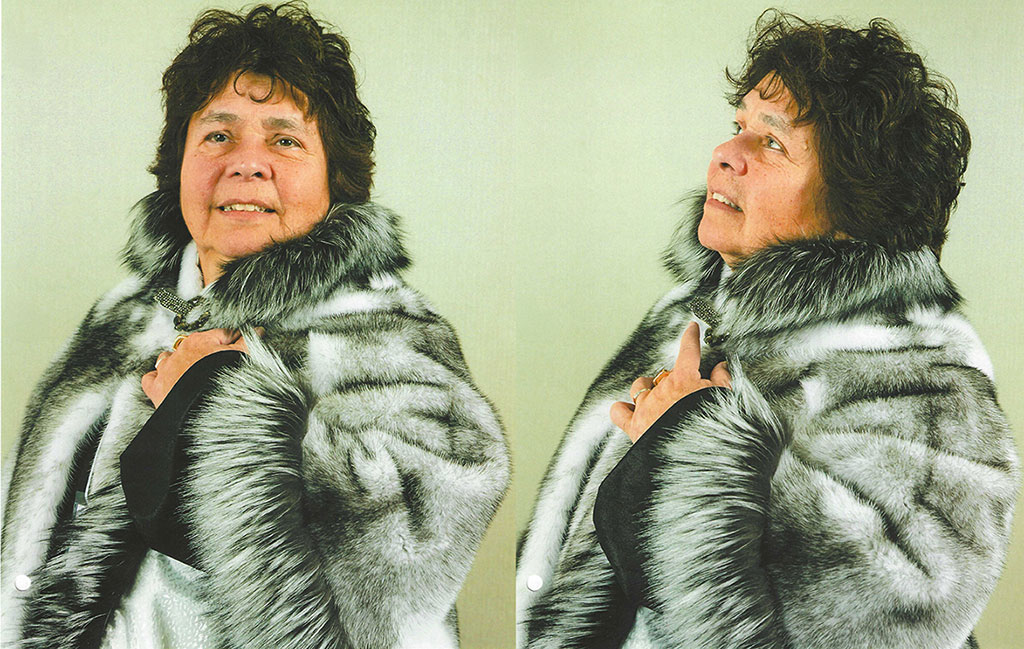
Modeling a blue fox coat with ranched silver fox trim, circa 1993.
My supervisor was Dr. Fred Gilbert, and I had two employees. Eventually the FIC trap development work moved to Vegreville. I had also moved to Alberta and was working for the Alberta Government as a fur biologist. I was still working with traps and trappers and had several trappers outfitted with new humane traps and new technicians to test over the winters. I also worked with government people from the other provinces who held similar positions to mine – such as Bob Carmichael (Manitoba), Mike O’Brien (Nova Scotia) and Pierre Canac-Marquis (Quebec).
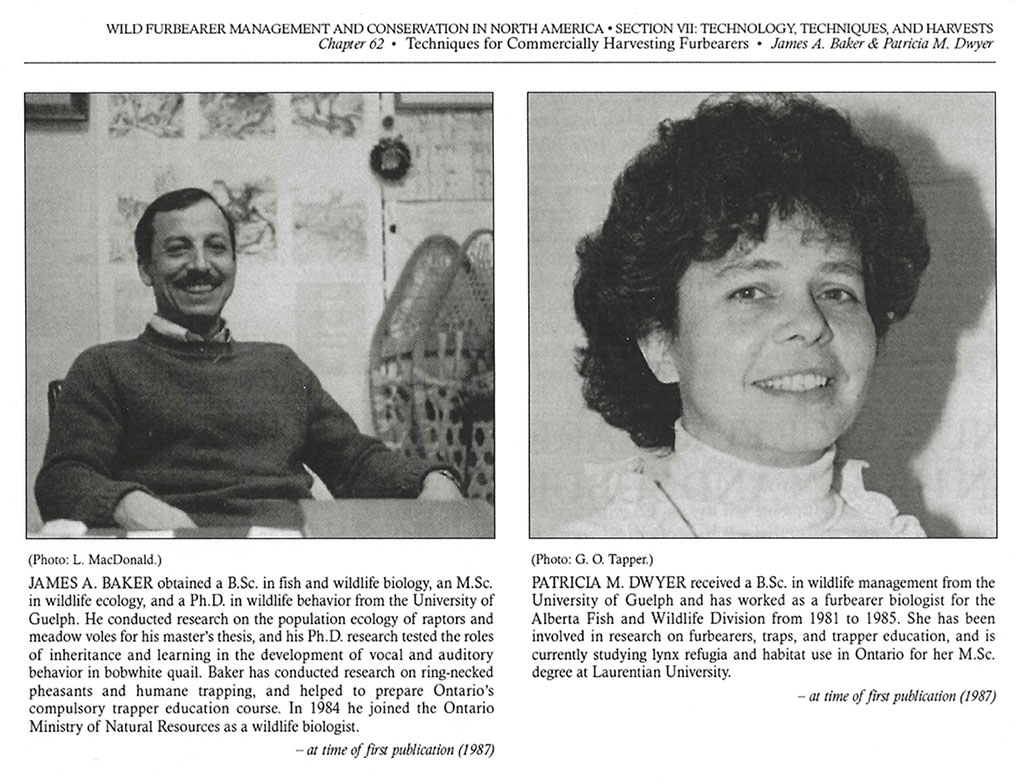
Way back in 1987, James Baker and I co-wrote a chapter in Wild Furbearer Management and Conservation in North America. Today, it's still considered the key document in its field.
Eventually I left to do a master’s under Dr. Frank Mallory on lynx cycles producing my thesis “Location and Characterization of Lynx Refugia of Ontario”, at Laurentian University in Sudbury, supported by the Ontario Ministry of Natural Resources and my many friends and family. During that time, I collaborated with Jim Baker on a chapter in the trapping bible by Milan Novak, Wild Furbearer Management and Conservation in North America.
Canadian fur managers bonding, Quebec City, 2008. L-R: Felice Griffiths, Kim Morgan, Carol Foster, and Patricia Dwyer.
Following that and before graduating, I attended University of Ottawa at the Law school. I graduated from my master’s and law degrees on the same May weekend in 1992. Upon graduation I worked for the Department of Indian Affairs and Northern Development in the trapping section, doing consultations with Aboriginal peoples on humane traps. Brian Roberts and Smokey Bruyere were my mentors and supervisors in this position.
Canadian Fur Managers committee, St. John's, 2010. L-R: Randy Dibblee, Patricia Dwyer, Eric Lofroth, Shannon Crowley, Dean Berenzanski, Chris Heydon, Rob Corrigan, Jean-Michel DeVink, Helen Slama, Pierre Canac-Marquis, Mike O'Brien, and Devin Imrie.
I was soon asked to join the Canadian Wildlife Service, to do consultations and help facilitate the changes to the Migratory Birds Convention 1916. With the acceptance of the Constitution Act, 1982 it was necessary to acknowledge and accept the rights of the Aboriginal Peoples of Canada to hunt migratory birds during the closed season for subsistence purposes. I requested and was given permission to form a negotiation committee with Aboriginal peoples on the team. The Honourable James Bourque, who was the Deputy Minister of Environment in the Northwest Territories, worked with me along with Philip Awashish from the Crees of Quebec and Rosemary Kuptana, the then president of the Inuit Tapiirisat of Canada. I have always thought of this successful endeavour as one of the first Federal government actions of reconciliation to Indigenous peoples.
At CWS, I was Chief of Aboriginal Affairs and Transboundary Wildlife for 20+ years. Presently, I am on the Executive of the Canadian Wildlife Federation (NGO) and slated to become in two years the first woman, and first Indigenous president.
The Power of Community and Collaboration
Canadian Fur Managers committee, Ottawa, 2013. L-R: Helen Slama, Mike O'Brien, Jonathan Cormier, Emmanuel Dalpé-Charron, Dave Kay, Patricia Dwyer, Pierre Canac-Marquis, Christy MacDonald, Brad Potter, and Dean Berenzanski.
Conservation, I discovered, is not a solitary pursuit. Through workshops, conferences, and collaboration with other students and professionals, I became part of a network dedicated to wildlife conservation. We shared findings, debated best practices, and supported each other through successes and setbacks. One of my most formative experiences was working on co-management agreements in the new treaties with Indigenous peoples. The project required coordination between hunters and trappers, Indigenous communities, and government lawyers and biologists – a reminder that conservation is as much about people as it is about animals.
I learned to listen as much as to speak, absorbing traditional ecological knowledge and local stories that textbooks never capture. The wisdom passed down by Indigenous Elders about the cyclical nature of animal populations and the importance of gratitude after each successful track or capture added depth to my scientific understanding.
I am humbled and so grateful to so many people who helped me to understand and to grow along my journey, and to have been able to express myself throughout. Receiving the Jim Bourque Award is an amazing gift of recognition which I never expected. Jim was a close friend of mine and a person I highly respected.
The Fur Institute of Canada’s (FIC) 2025 Annual General Meeting in Edmonton, Alberta, started with a bang! Five days of… Read More
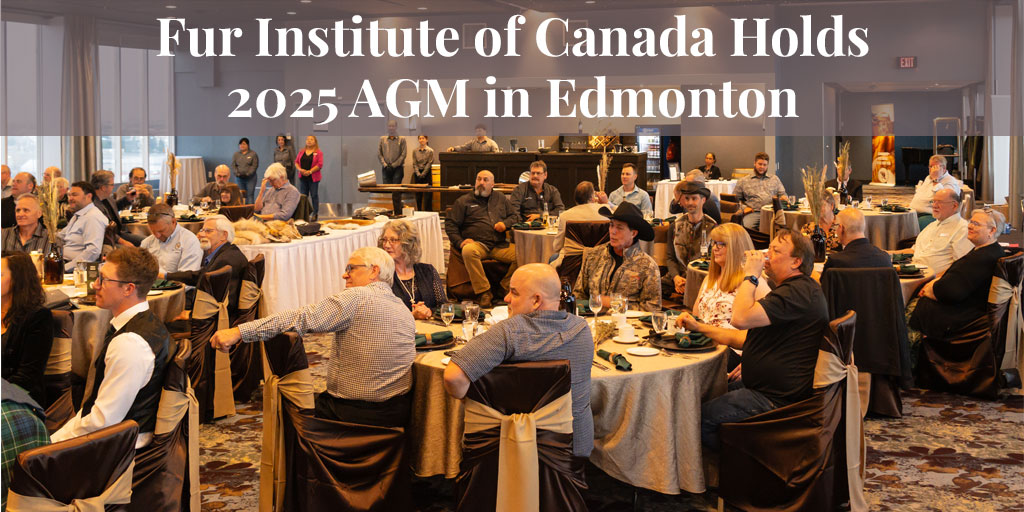
The Fur Institute of Canada's (FIC) 2025 Annual General Meeting in Edmonton, Alberta, started with a bang! Five days of meetings, from June 10-14, were scheduled to be held at one venue, but at the eleventh hour an electrical fire knocked out half the conference centre, forcing everything to be moved next door! Thankfully, the staffs of both venues, and of the FIC, were equal to the task, and made the huge upheaval look like nothing.
Meanwhile, the AGM took place against the backdrop of the Stanley Cup Final of the National Hockey League, between the local Edmonton Oilers and the Florida Panthers. Needless to say, Oilers fans were out in force, but sadly there was no fairy tale ending. On June 17, the Panthers clinched their second-consecutive Cup in game six of the best-of-seven series.
As for the comparatively undramatic meetings themselves, the focus was on provincial / territorial collaboration, both amongst regulators and trappers. Regulations were the purview of the Canadian Furbearer Management Committee, made up of government wildlife managers, while updates on the latest developments in humane trapping fell to the FIC's Trap and Research & Development Committee.
The week also featured a long-anticipated and well-overdue meeting of Trappers’ Associations from coast to coast. The meeting was well attended, with the majority of provincial trappers’ associations in Canada in attendance. Stay tuned to Truth About Fur for a future piece centred on this meeting.
"Provincial and territorial governments and trappers associations are essential to guiding the work of the Institute," said FIC Executive Director Doug Chiasson. "It was great to have so many of them represented here in Edmonton, and we look forward to even more attending our next AGM."
Social Events
Fort Edmonton was the perfect setting for team-building. Photo: Deborah Hinter.
Day three was given over to socialising, combining an afternoon at Beaverhill Sporting Clays shooting range followed by dinner at Fort Edmonton Park, hosted by the Alberta Trappers Association and Canadian Coyote Company.
As the organisers of any such event will tell you, a little fun and games is an essential part of team-building. And if it involves firearms (no animals were harmed!), a spectacular historical setting, some of the best steak many could remember, listening to a cowboy balladeer beside an open fire, and cheering on the Oilers on a tablet in their victorious Game 4, so much the better!
"The FIC AGM is always a great chance to get together with the FIC membership from across Canada, handle some serious business and have a good time as well,” said FIC Chairman Jason White.
Banquet and Awards
The Honourable Todd Loewen addresses the FIC banquet. Photo: Deborah Hinter.
Following the conclusion of the AGM, the FIC hosted a banquet with keynote speaker the Honourable Todd Loewen, Alberta's Minister of Forestry and Parks. As a dedicated trapper and outdoorsman himself, Todd was certainly among friends.
Also present to greet the banquet was another outdoorsman, MP Blaine Calkins. Blaine is currently chair of the Conservative Hunting and Angling Caucus.
Greetings to the banquet were given by MP Blaine Calkins, representing Alberta's Ponoka-Didsbury riding.
Then came the Awards ceremony, with FIC Board member Serge Larivière, of the Cree Hunters Economic Security Board, acting as master of ceremonies. Awards were given to five recipients.
Bryant White was an obvious winner of the Neal Jotham Award.
The Neal Jotham Award, sponsored by the Saskatchewan Trappers Association, went to Bryant White, a wildlife biologist and Furbearer Research Program manager with the Association of Fish and Wildlife Agencies. Bryant's work focuses on coordinating projects involving US state and federal wildlife agencies, especially research related to Best Management Practices for the conservation of furbearers.
Patricia Dwyer with her fully deserved Jim Bourque Award.
The Jim Bourque Award, sponsored by the International Fur Federation, went to Patricia Dwyer, a director of the Canadian Wildlife Federation. Long a proponent of humane trapping, the career of this Métis resident of northern Alberta has included positions with the Federal and Provincial Committee on Humane Trapping and the Department now known as Crown-Indigenous Relations, and over 20 years of experience as the Chief of Aboriginal Affairs and International Wildlife with the Canadian Wildlife Service.
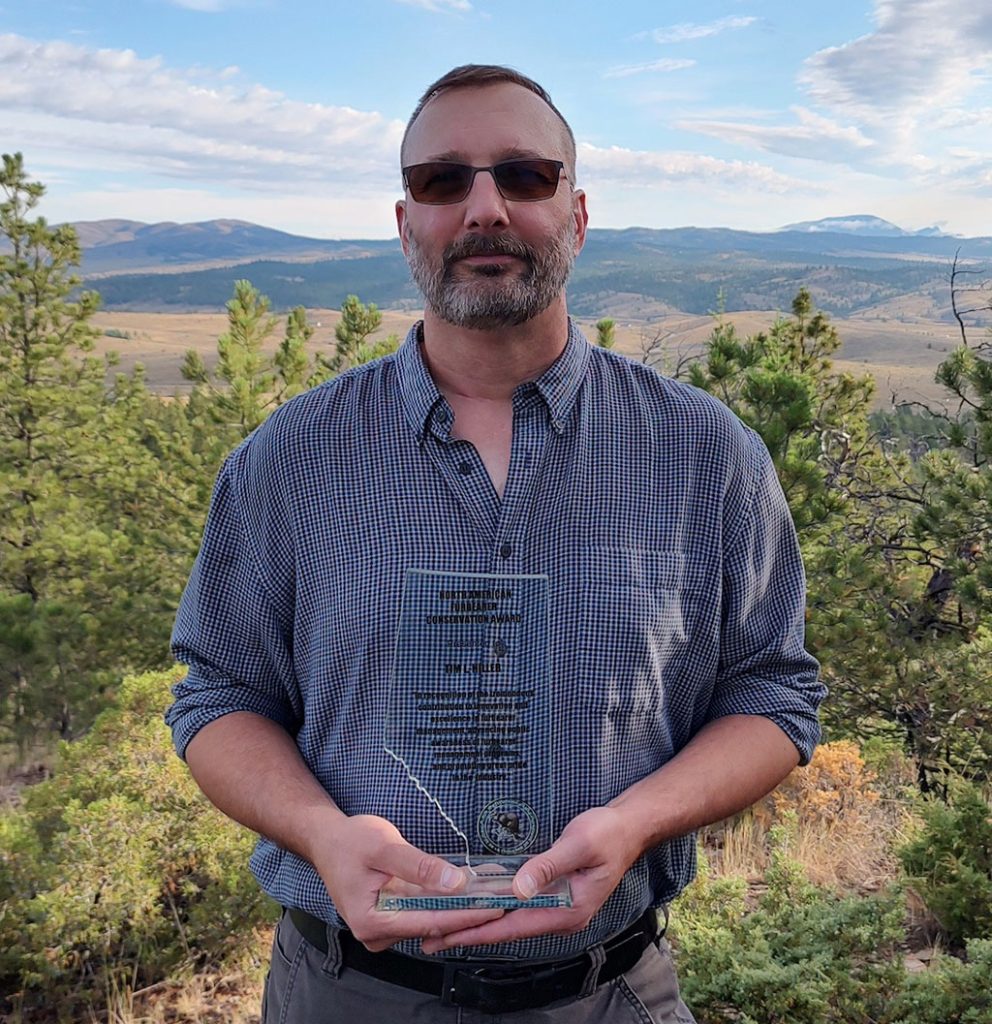
Dr. Tim Hiller proudly displays his North American Furbearer Conservation Award.
The North American Furbearer Conservation Award went to biologist Dr. Tim L. Hiller, founder and executive director of the Wildlife Ecology Institute in Helena, Montana. Tim also heads a team of editors now undertaking the daunting task of updating the 1,150-page Wild Furbearer Management and Conservation in North America, considered the key reference in its field. Colloquially known as "the bible for furbearer management", the tome has not been updated since it was published in 1987.
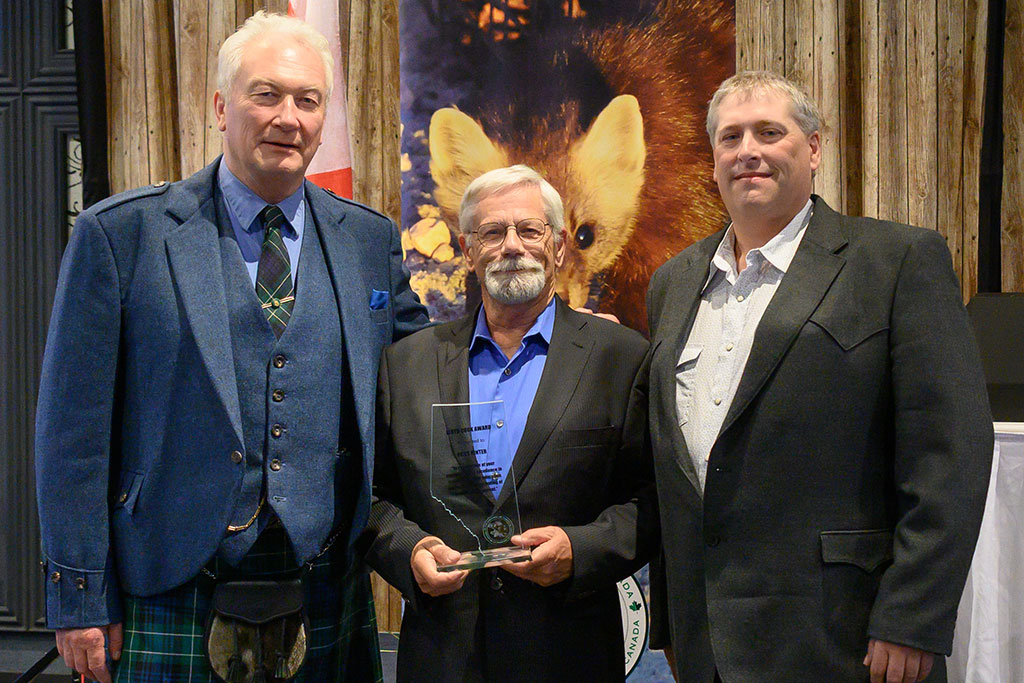
Lloyd Cook Award winner Ross Hinter is flanked by Bill Abercrombie and Kevin Klein, President and Vice-President of the Alberta Trappers Association. Photo: Deborah Hinter.
The Lloyd Cook Award, sponsored by Fur Harvesters Auction, went to Ross Hinter, Public Liaison and Program Development Coordinator of the Alberta Trappers Association. Together with wife Deborah, Ross also operates North Trapping & Bushcraft, teaching trapping, traditional hide tanning, resolutions to human / wildlife conflicts, and other workshops. Ross has been teaching for more than three decades, throughout Alberta and British Columbia.
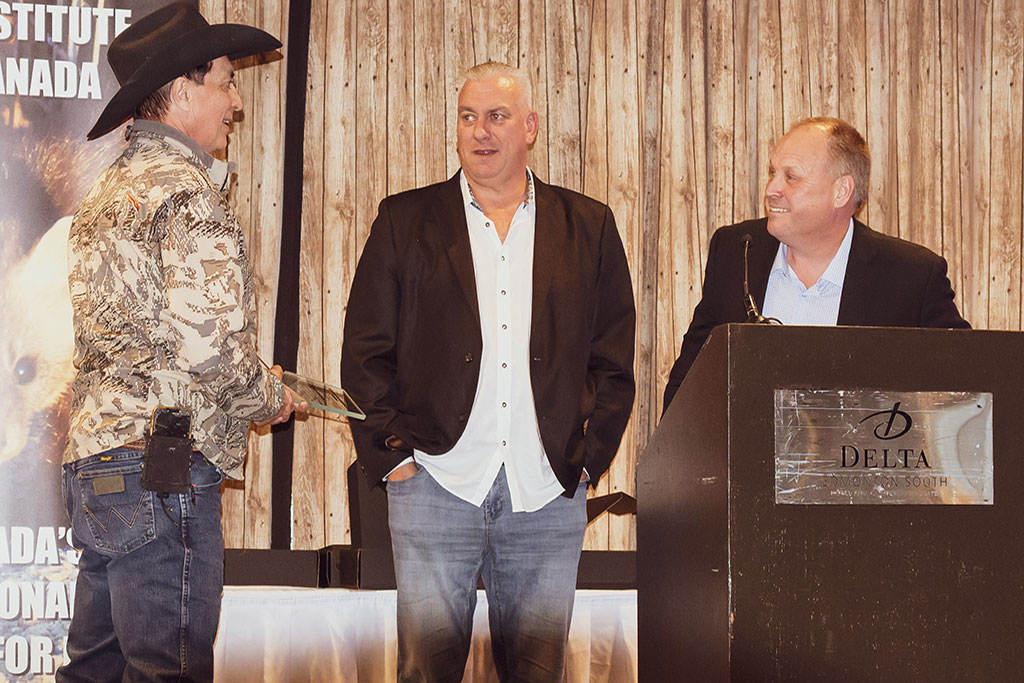
Gordy Klassen accepts his Lifetime Achievement Award from FIC Chairman Jason White and master of ceremonies Serge Larivière. Photo: Deborah Hinter.
The Fur Institute of Canada Lifetime Achievement Award went to Gordy Klassen. A past president of the Alberta Trappers Association and FIC Board member, Gordy has put his time, effort and money into helping educate trappers about the importance of furbearer management, and has hosted countless meetings at his own homestead.
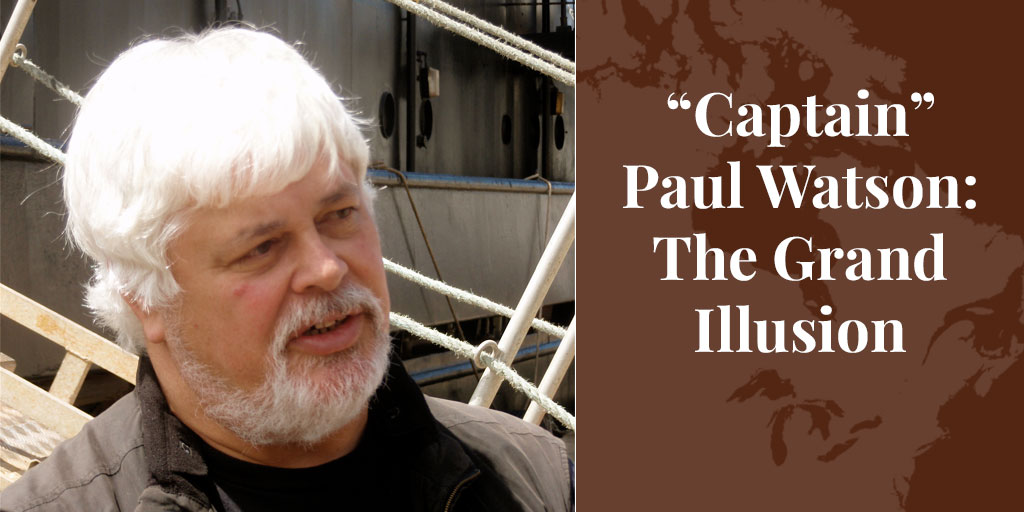
Lately, I forced myself to watch the quite popular Paul Watson : Une vie pour les océans [Paul Watson: A… Read More
Paul Watson is troubled, megalomaniacal and dangerous. Photo: Witty lama, CC BY-SA 3.0, via Wikimedia Commons
Lately, I forced myself to watch the quite popular Paul Watson : Une vie pour les océans [Paul Watson: A Life for the Oceans], broadcast on the European public service TV channel Arte. After learning that I appeared in it, I sort of had no choice but to check it out, right?
Full disclosure: I don’t like Watson, and you’ll quickly understand why.
The advertising film (because that’s what it really is) tries to ennoble the pseudo captain – a fake title that suits his equally fake character very well.
Because, if the "captain" has neither title nor official certification, he is part of a short list of characters who have managed, like other guys of the genre (for example UFO religion founder Raël, International Fund for Animal Welfare [IFAW] founder Brian Davies, and wealthy televangelist Joel Osteen), to make a living with others’ money, and that, before the advent of web influencers. Applying a well-tested recipe, these characters have all experienced a "moment of awakening". Raël, for example, was abducted by aliens, while Osteen was contacted by God. For Watson, the epiphany came from the eye of a dying sperm whale. In the narrative, it looks chic.
One can, of course, romanticize Watson's life, as Arte has done so well. Or one can see it for what it really is.
Violent Temperament
https://www.youtube.com/watch?v=vHtn13rca_o
Paul Watson is known today for his shock of white hair, but he wasn't always that way!
Like hundreds of thousands of young people, especially in the 1970s, Watson wanted to change the world, and participated in protests of all kinds. Environmental issues were starting to get traction around that time. He joined Greenpeace, which quickly kicked him out in 1977 because of his instability and violent temperament. As he relates in the long Arte commercial, his father was violent, and his mother died when he was still young. Any human being remains marked by this kind of childhood.
A year later, in 1978, he gave an interview to Barbara Frum of the Canadian Broadcasting Corp. (CBC) in which, in an attempt to take revenge on his former colleagues, he revealed the true motivations and financial tactics of these activist groups. Decades later, their tactics are still the same: using charismatic species to get donations from people. Truly endangered species, if non-charismatic, rarely get attention.
When Watson realized that his strategy did nothing to diminish donations to Greenpeace, he created the Sea Shepherd Conservation Society (SSCS) and used the same tactics, with the same animal that filled the coffers of Greenpeace and IFAW: the seal.
It was during this period that I met Watson in the Magdalen Islands. You can see me for a few seconds in his commercial ... without my permission, of course. I am the only one who speaks in this excerpt (as French is my first language, my English is a little broken!), but not the only one whose images have been used without permission and who would refuse to be associated with such a criminal.
He and his minions would like the world to believe that the Magdalen Islanders expelled him (to put it politely) from their archipelago because they were drunk and hated him for wanting to "save the baby seals", but that's obviously very far from the truth.
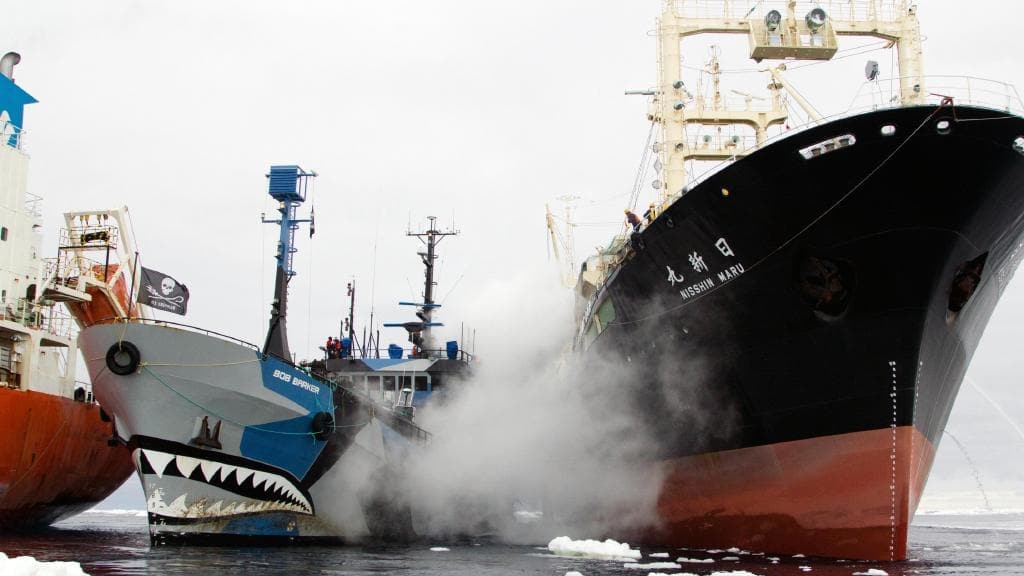
On several occasions throughout his career, Watson has instructed his crews to carry out maneuvers that endanger the lives of sailors, fishermen, hunters, husbands, fathers, and friends. The sailors of the Magdalen Islands have not escaped his intimidation techniques and they hated him for his scatterbrained and dangerous behaviour.
In the few minutes that Arte devotes to this episode, Watson tells more lies than I can relate here, but the funniest is when he claims to have "knocked out three of them with my stun gun". Even today, 30 years later, if you were to run into one of these sturdy guys, you'd quickly realize that the "captain" was no match for anyone in the group, even with the stun gun he invented to make it sound more Hollywood-like.
More precisely, when the dozen hunters entered the room, he crashed to the floor, livid, fear having sawed off his legs.
He knew exactly what he was doing when he came to taunt them on their own turf with his wacky proposal. As usual, he came to collect media images that he would use in fundraising activities. Efficient deceptions still require some effort and investment.
Since he was born not far from the Magdalen Islands, in New Brunswick, he would have been well aware of the affable nature of the people of the Maritimes. He certainly wouldn't have been treated with the same leniency in several other regions, as he surely knew very well.
Paul Watson has built his entire career on provocation. In 2008, when four Magdalen Island sealers lost their lives at sea, Watson couldn't resist shining a spotlight on himself by sullying their memory. His comments enraged all sailors worthy of the name, and, in solidarity, fishermen from the French territory of Saint-Pierre-et-Miquelon cut the moorings of his boat while docked on their archipelago. "Il peut revenir, mais à ses risques et périls," their representative said at the time ["He can return, but at his own risk."]
In truth, Watson is a troubled, megalomaniacal and dangerous being. Not in great physical shape, he's had no choice but to calm down with age, but that does not forgive his past actions.
It’s nothing short of a miracle nobody has died because of his reckless actions. Sure, lots of alcoholics drink and drive their whole lives without killing anyone, but that doesn’t mean they shouldn’t be taken out of circulation for everyone’s sake.
Watson only shifted to the whale-saving business because most of the funds intended for the rescue of "baby seals" was going to other organizations that were similar to his own but more effective in their propaganda and disinformation campaigns since they used media stars to reach people’s pockets. At the SSCS, he was the star, and he couldn't stand sharing the spotlight.
He says it himself in his interview with CBC: "There are over a thousand animals on the [US] Endangered Species List, and the harp seal isn't one of them." And nor is "the whale" because there is no such thing as "the whale". There are almost a hundred species of cetaceans. Some populations are doing well, others less so, but Watson does not trade in subtlety; it would become too complex for his generous admirers.
It was more valuable to create "THE whale" – the majestic, singing, intelligent, protective, wise one – the charismatic one. The one that brings in money for its valiant defender.
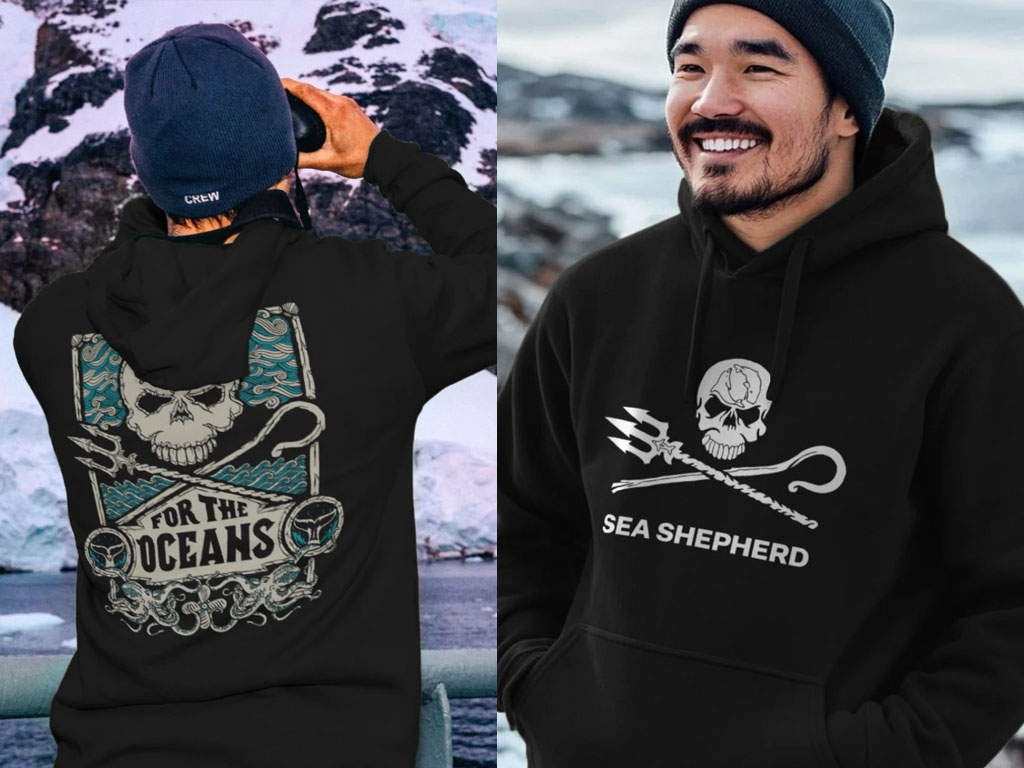
Watson went all-in with the bad boy persona (as much of the Sea Shepherd artwork proclaims loud and clear), and he naturally had the personality to match: the one who decides right and wrong, who doesn't have to follow the laws of inferior beings, i.e., all those who think otherwise. An interesting marketing strategy.
To simplify things further, Watson decides alone who’s poaching – not the competent authorities, the scientists or the sovereign nations. And whoever contradicts him obviously becomes the villain in his narrative. Sometimes in a Hollywood movie, the one who defies authority becomes the hero, but, unfortunately for him, in reality, that's also what defines a criminal.
"Empathetic Predator"
For decades now, I’ve been wondering why even seemingly brilliant minds sometimes fall for such devious characters and their masquerades.
Religious gurus have been around since the dawn of humanity, a phenomenon that is well documented. But environmental gurus (the environment being sort of the new religion) operate on new parameters.
When I discovered the fascinating work of the French ethnologist Charles Stépanoff, I found some clarity as a couple of our specie’s particularities caught my attention. Cooperative parenting, as an example, incites us to take care of offspring other than our own. And trans-species empathy allows deep feelings for otherness. The plethora of interactions between humans and other species, mixing ownership, companionship, domestication and sometimes even a form of family love, presents a complexity that is, indeed, difficult to match elsewhere in nature.
Most of the time, people living in natural, rural settings weave complex links with animal otherness. For example, a farmer can consider a dog or cat as a family member, spend nights watching over a sick cow, and also slaughter pigs. The entanglement of those forms of relationship are common and widespread. These people usually see themselves as an integral part of nature. Stépanoff qualifies their interspecies relationship as a “réseau dense" ["dense network”]. They love nature so much that they choose to live in its midst.
On the other hand, urban faunae maintain much simpler links with nature and other animal species. In the city, plants are potted, birds are caged, and cats are neutered. As for the people themselves, they visit a countryside they would prefer to be virgin and wild, like the ones they saw on National Geographic channel. They observe nature from afar and want to protect it, while removing any sign of it from their sterile environment at home. For the ethnologist, they maintain a "réseau étendu" [“spread network”] with animal otherness. Their lack of closeness with nature makes them vulnerable to animalist groups’ simplified rhetoric.
Besides, from a young age, we’re all comforted by plushies, anthropomorphized critters and Walt Disney’s cartoons. Some simply never really grow out of it.
On top of that, our world is increasingly urbanised, and those dense pockets of voters hold the balance of power in most democratic societies. In other words, those of us who are the most disconnected from nature are the ones calling the shots for us all, which explains in large part why our environment is deteriorating.
Paradoxically, urbanites believe they are part of the solution, not the problem. At best, letting them decide what’s ecologically sound is counterproductive. Most of the time, it is eco-colonialism in its purest form.
Stépanoff speaks of Homo sapiens as a "prédateur empathique" ["empathetic predator"]. Our ability to imagine ourselves in our prey’s position makes us an excellent hunter, but, without discernment, our empathy also requires us to question the morality of taking lives. Indeed, if you picture yourself in the prey's position, killing becomes a tragedy to avoid.
Some groups and individuals have turned this human duality into a business and prey on those of us who don’t maintain a dense network of relations with animal otherness. I don’t give them credit for that finding. Brian Davies, founder of IFAW, was one of the first to uncover the immense economic potential of this human singularity with seals in the 1970s, but that was a total fluke.
Most of those groups are disembodied ideological organizations such as IFAW, People for the Ethical Treatment of Animal (PETA) or Greenpeace. Others, such as the SSCS, rely heavily on a single persona – in this case, "Captain" Paul Watson.
His feat is to have succeeded in convincing an impressive number of people of his act. Many have tried to apply the formula: "A lie repeated a thousand times becomes the truth," but before the Internet, few have succeeded on a large scale. It’s also true that the lone ranger fighting against the evil corporation story fits well in the now popular “conspiracy theories”. It’s all very poetic and everybody loves bedtime stories.
Logo, slogans, shocking images, charismatic species, good vs evil … the man knows how to manipulate the media and the masses, I’ll give him that much.
Does he still believe his own actions are well-founded? Of course. They've brought him fame and fortune, and his entourage identify him with this facade. After just a couple of years of that regime, there was no turning back. He became the character he had created, and it served him well too. I’m sure it’s the same with Raël and all other gurus.
Here, I would like to make a distinction. Most followers of these activist groups are sincerely hoping to do some good for the environment. Because of their urban living and natural empathetic disposition for otherness, they just don’t know any better. Leaders of those movements don’t have such excuses. Being fatly paid full-time to improve their knowledge on those issues, they either should know better and are being dishonest about it, or suffer from intellectual deficiency which, to that extent, is unlikely.
Beyond lying, individuals who take advantage of other humans’ weaknesses to enrich themselves leave negative impacts in their wake. Watson is no different.
Ecological Criminal
Thanks to Paul Watson et al., the grey seal population today is creating havoc in Eastern Canada. Photo: Christine Abraham.
By helping to over-protect seals, Watson has also contributed to weakening the Gulf of St. Lawrence’s ecosystem in Eastern Canada. Since the debacle of the sealing industry, over-predation by these pinnipeds has had a huge negative impact on the marine biodiversity of the region. Hunters and fishermen predicted that much as early as the 1980s, but today, it is scientists who have no choice but to admit it. The grey seal population in Eastern Canada has grown from about 5,000 in the 1970s to 400,000 today. Multiply the population of any apex predator by 80 in any given ecosystem and, of course, you’re going to create havoc.
Yes, you’ve read that right; Captain Watson is also an ecological criminal.
Isn’t this the ultimate irony? Animalist groups have created the perfect loop: the more money you give them, the worse the environment becomes. And the worse the environment becomes, the more money people give them.
Of course, society needs people to take care of nature's biodiversity, but not just anybody. Ecosystems are complex, more so than, let’s say, air traffic control. Would you let someone without any proper training or credentials direct plane landings? Of course not. So why trust a fake captain with it? If we’re not happy with the way our ecosystems are being managed, we need to train those in charge better, not follow the first self-appointed guru.
There it is. The grand illusion. People who give support to these groups think they’re contributing to a better planet while doing exactly the opposite.
Now you know. The disappearance of Atlantic cod, yellowtail flounder, white hake and many other fish species does not bother the noble captain in the slightest.
It is not Watson who will go bankrupt; it is the evil fisherman in his 17-metre boat. Watson is not the one who will have nothing left to feed his children, since his fortune is assured. It is not his community that will decline since he now lives in France. Who cares about uncharismatic species that are not even good for a small fundraising activity? Biodiversity? Bah … who cares?
On June 21-22, the Fur Institute of Canada held its Annual General Meeting in Corner Brook, Newfoundland and Labrador, and… Read More
FIC Executive Director Doug Chiasson with Howard Noseworthy, MP Gudie Hutchings, and Ross White.
On June 21-22, the Fur Institute of Canada held its Annual General Meeting in Corner Brook, Newfoundland and Labrador, and presented three awards honouring lifelong contributions to animal welfare and conservation of furbearers.
The awards vary from year to year, with this year's presentations being the Neal Jotham Award, the North American Furbearer Conservation Award, and the Lloyd Cook Award. .
Ross White receives his Neal Jotham Award from FIC president Jason White.
First presented by the FIC in 2014, the Neal Jotham Award recognises its late namesake's contributions to animal welfare, and in particular his leadership in creating international standards for humane trapping systems.
Sponsored by the Saskatchewan Trappers Association, this year's award went to Ross White, a prominent figure in the wild fur trade for many years.
White is a long-time active member of the Trappers Association of Nova Scotia, including serving on its Board. Above all, he is known as a tireless advocate for trapper education and engagement, and for introducing the next generation to trapping.
White played a key role behind the scenes in negotiations in the mid-1990s on the Agreement on International Humane Trapping Standards (AIHTS). Though officially an inter-governmental process involving Canada, the US, the EU and Russia, Canada's negotiating team recognized the value of accessing the best available knowledge that only trappers could provide. White was key in making sure trapping associations provided the funding needed to enable Howard Noseworthy (see below) to stay in Brussels to support and advise North American negotiators.
Said FIC Board member Mike O'Brien in his presentation speech, "He ‘got’ the changing world that trappers are working within and the need for trapping practices and trapper education to develop and evolve to respond to the changing world. He understood fully the importance of improving trapping practices and trapper knowledge and skills, and of achieving inherent acceptable levels of animal welfare as critical to maintaining the social licence to trap and sustainably harvest wildlife."
North American Furbearer Conservation Award
Howard Noseworthy receives his award from FIC president Jason White.
The North American Furbearer Conservation Award, initiated by North American Fur Auctions and continued by the FIC, recognises individuals and organisations that have made significant contributions in the sustainable management of furbearers. This year’s award went to Newfoundland native Howard Noseworthy.
In 1981, Noseworthy became President of the Newfoundland and Labrador Trappers Association, overseeing the province's implementation of a mandatory trapper education program. Upon stepping down as President, he assumed the role of Trapper Education Coordinator.
From 1992-97, he served on several joint Canada-US delegations to the EU, meeting with parliamentarians and bureaucrats to explain North America's trapping regime and model of wildlife conservation, and the need for the AIHTS. Concurrently, he was a member of the Canadian Advisory Committee to ISO TC 191 on the development of humane trapping standards, eventually leading to the trap-testing standard that now underpins the AIHTS.
As a resource person to the Canadian delegation negotiating the AIHTS, Noseworthy was described by Don Maclauchlan, then with the Association of Fish and Wildlife Agencies, as "a rock – a reliable and steadfast fountain of insightful and accurate information that we so desperately needed."
During the same period, Noseworthy also facilitated the union of the Canadian Trappers Federation and Trappers Alliance into the Canadian National Trappers Alliance, serving as President until 1997.
From 1997 until 2008, Noseworthy served as General Manager of the Ontario Fur Managers Federation, which took on many of the former roles of the Ontario Ministry of Natural Resources, including trapper licencing and education.
In 2008, Noseworthy moved to Fur Harvesters Auction, still in Ontario, as Director of Planning & Development, a position he holds to this day. At the FHA, he has overseen efforts to promote wild fur internationally, including playing a major role in the development of the North American Wild Fur Certification protocol which acts as the basis for audits of wild fur certified under the International Fur Federation's Furmark program.
Said Nova Scotia trapper Ross White of Noseworthy, "This man has the ability to take a big problem and reduce it with just a few words. He is thoughtful, respectful and forward-thinking. ... Having this man, as intelligent as he is, representing the fur industry is a big plus when things have to move forward."
In this 1985 episode of CBC's Land & Sea: Trappers in the autumn in Labrador, Frank Phillips advocates for trappers to switch from legholds to conibears.
First presented by the FIC in 1993, the Lloyd Cook Award recognises the commitment of its late namesake to excellence in trapping, trapper education, and public understanding of wildlife management. Among the posts held by Cook in his lifetime were President of the Canadian Trappers Federation and of the Ontario Trappers Association, forerunner of today’s Ontario Fur Managers Federation.
Sponsored by Fur Harvesters Auction, this year’s award went to Frank Phillips, who unfortunately was unable to attend our AGM.
In the 1980s, Phillips was instrumental in starting trapper education within the Wildlife Department in Happy Valley-Goose Bay, Labrador. He adapted the Ontario trapper education course for use in Newfoundland and Labrador, and also authored the province's version of the manual.
He also conducted trapper education and pelt-handling courses throughout Labrador, often traveling by snowmobile. Among his teachings were how trappers could get better prices for pelts by dealing directly with their provincial trappers association, and the importance of switching from traditional leghold traps to more efficient and humane traps, such as conibears.
On July 28-29, the Fur Institute of Canada descended on Whitehorse, Yukon, for its first in-person Annual General Meeting in… Read More
On July 28-29, the Fur Institute of Canada descended on Whitehorse, Yukon, for its first in-person Annual General Meeting in three years, and also to mark its 40th anniversary. As part of the celebrations it revived its Awards Program, honouring lifelong contributions to the fur trade.
This year, three awards were presented: the Lloyd Cook Award, the Honorary Lifetime Membership Award, and the North American Furbearer Conservation Award.
Lloyd Cook Award
Robert Stitt (centre) receives his Lloyd Cook Award from Ryan Sealy and family, at the Jubilee Mountain fire tower where he works in the summer.
The Lloyd Cook Award was first presented by the FIC in 1993 in recognition of its namesake's commitment to excellence in trapping, trapper education and public understanding of wildlife management. Among the posts held by Lloyd in his lifetime were the presidency of the Canadian Trappers Federation and of the Ontario Trappers Association, forerunner of today's Ontario Fur Managers Federation.
This year's Lloyd Cook Award went to Robert Stitt, a valued member of the FIC for almost two decades. Robert was unable to attend the presentation, so the award was accepted on his behalf by Ryan Sealy, a conservation officer with the Government of Yukon.
Robert grew up in Ontario where he spent decades trapping and guiding hunters, before moving to Yukon in 2008. One of the first things he did on arriving was to join the Yukon Trappers Association (YTA), and, despite his enormous experience, signing up for the territory's Basic Trapper Education course. To this day, he is a director of the YTA, as well as being a past president.
For the past 15 years, Robert has run a trapline in a remote part of southeast Yukon, harvesting marten, beaver, wolf and wolverine. In most years, he offers upgrading workshops, particularly for marten and beaver pelt-handling and management, and also provides a mobile fur depot service in several communities.
In 2011, Robert became a guest presenter for the Yukon Government's trapper education program, and in 2020 became an instructor. Students regularly comment on his close connection to the bush, his willingness to help new trappers, and his strong advocacy for humane trapping and good fur-handling.
Indeed, Robert's fur-handling skills are renowned, and the reason he has won many competitions. When teaching, he highly recommends his students read the Fur Harvesters Auction manual Pelt Handling for Profit.
Robert's other claims to fame are diverse. He is known as a presenter and writer, regaling audiences with inspirational tales of overcoming extreme challenges in the wilderness. He often writes letters to the editor on wildlife management issues, has published several stories about his life on the trapline, and is a regular contributor to Canadian Trapper magazine. And he is also a renowned moose-hunting guide, and a valued reporter on birds and other wildlife on his trapline.
Honorary Lifetime Membership Award
Harvey Jessup receives his Lifetime Membership Award, watched by the FIC's Executive Director Doug Chiasson and Chair Jason White.
The FIC's Honorary Lifetime Membership Award celebrates people with long and distinguished track records of service to the fur trade, this year going to a man who has been involved with the institute from its inception, Yukon resident Harvey Jessup.
Harvey started his career in fish and wildlife management as a conservation officer, moving from enforcement to management in 1977 as a furbearer technician assisting with research on furbearer species such as marten, beaver, lynx, wolverine and wolves. This research led to the development of trapline management strategies for these key species. With the assistance of many Yukon trappers, the Yukon Trappers Association, the Manitoba Trappers Association, and the Canadian Trappers Federation, he developed a trapper education manual and training program for Yukon that is still in use today. He sat on the Western Canadian Fur Managers Committee which would later be incorporated into the Canadian Fur Managers Committee.
In 1982, Harvey became the fur harvest manager responsible for traplines, monitoring fur harvest and delivering trapper training. He continued as a member of the Canadian Fur Managers Committee. He attended the founding meeting of the FIC, was appointed to its first Board, and went on to serve for over 20 years. He held positions on the Executive and chaired the Trap Research and Development Committee for six years. He also participated on ISO191 through to the development of the Agreement on International Humane Trapping Standards.
His responsibilities with Environment Yukon expanded to include all wildlife harvest, managing licensed hunting, determining outfitter quotas and tracking harvest. He eventually became Director of the Fish and Wildlife Branch, before retiring in 2009.
In 2010, he was appointed to the Yukon Fish and Wildlife Management Board (YFWMB), a government advisory body established under Yukon First Nation Final Agreements, and served as chair for two years. Interestingly, the Director of Fish and Wildlife is identified in the Land Claim as the YFWMB's technical support, so Harvey has sat on both sides of the table so to speak!
In 2015 he was appointed to the Yukon Salmon Sub-Committee, a Land Claims advisory board on all matters pertaining to salmon in Yukon, again serving as chair for two years.
Throughout the latter part of his career and while sitting on the YFWMB, Harvey worked closely with Renewable Resources Councils, local government fish and wildlife advisory committees that have direct responsibilities for all matters pertaining to trapping.
Harvey has had ties with the FIC literally from the beginning. At the FIC's first AGM, in 1984, Harvey can be seen in the back row, far left.
North American Furbearer Conservation Award
Mike O'Brien receives his furbearer conservation award at the FIC's 2023 AGM, flanked by Chair Jason White.
The North American Furbearer Conservation Award aims to promote awareness and recognition of individuals and organisations that have made significant efforts in the field of sustainable furbearer management. This year's award went to Mike O’Brien from Nova Scotia.
On graduating from Acadia University with a master's degree in wildlife biology, Mike worked as a wildlife manager for the Department of Natural Resources and Renewables of the Government of Nova Scotia. He then became a consultant for many different wildlife management sectors, including the wild fur trade.
Mike has been an FIC Board member since 1998, serving first on the Trap Research and Development Committee, and currently as chair of the Communications Committee. He is also a member of the Executive Committee.
This year marks the passing of four decades since the Fur Institute of Canada was founded in 1983, with the… Read More
This year marks the passing of four decades since the Fur Institute of Canada was founded in 1983, with the primary function of overseeing the testing and certification of humane traps. To mark the occasion, it has launched a new logo, but is the change purely cosmetic or is there more here than meets the eye? To find out, Truth About Fur interviewed Executive Director Doug Chiasson.
Truth About Fur: The FIC's original logo showed a beaver, a Canadian icon. Then it changed to another national icon, the maple leaf. Now you've combined the two, but with the beaver taking pride of place. What's the thinking here?
Doug Chiasson: When an organization celebrates a significant milestone, as the FIC is doing this year with our 40th anniversary, it's time for self-reflection. So we can see that while our most recent logo, of a maple leaf, did a great job of communicating “Canada”, it didn't communicate “fur” at all.
By putting a beaver front and centre, we remind people that fur and furbearing animals are our focus. And as a nod to the past, the maple leaf also appears in the roundel.
L: Canada's national animal stands watch on Parliament Hill. Photo: D. Gordon E. Robertson, CC BY-SA 3.0, via Wikimedia Commons. R: The beaver has graced the reverse side of the nickel since 1937.
TAF: Anyone with knowledge of Canada's history will understand the relevance of the beaver, but can you explain for non-historians?
DC: We often say that the history of the fur trade is the history of Canada. The pursuit of fur, particularly beaver pelts, was a defining feature of early European presence in North America and of relations with Indigenous nations. It played a role in establishing the Hudson's Bay Company and the North West Company, whose forts and factories are the sites of present-day communities across Northern and Western Canada.
That influence was reflected by the beaver's inclusion on the nickel coin since 1937, and its designation as Canada’s national animal in 1975.
Canada is fortunate to have a great diversity of fur resources, but when we think of fur and Canada, we think first of the beaver.
Absorbing Fur Council of Canada
L to R: Doug Chiasson with Mitch Fazekas of new FIC member Mitchie’s Matchings, Mathieu St-Arnaud of M-mode, and George Vongas of Saga Furs.
TAF: The Fur Council of Canada has been around since 1964, representing the interests of the downstream side of the fur business (retailers, manufacturers, etc.). Now the FIC is in the process of absorbing the FCC. Why is this happening, and why now?
DC: It's no secret that the fur industry, not only in Canada but around the world, has faced significant adversity in recent years. The war in Ukraine, Covid-19, climate change, and other factors have hurt the entire fur value chain. So the FCC found itself in a position where it could no longer deliver on its mandate as a stand-alone organization.
TAF: So with the FIC now representing the upstream and the downstream sides of the fur trade, how will the entire trade benefit?
DC: In the past, having two national organizations representing the fur trade could cause confusion, but those days are over. Having just one organization represent Canada across the whole spectrum of the fur trade will put us all in a stronger position when it comes to advocating for fur. Whether we're talking to government, the media or consumers, there should no longer be any doubt that Canada's fur trade speaks with one voice.
TAF: From its founding, the FIC's primary role has been the testing and certification of humane traps, so it's understandable that your membership includes a lot of trapping associations. Will the FIC now be looking to broaden its membership base?
DC: As you say, the trap testing and certification program has always been a major motivator for trapping associations to support the FIC. That will not change with these recent developments. Other sectors of the trade have always been welcome to become members, but usually they would choose to join either the FIC or the FCC. Now there is no need for them to make that choice.
We're also no strangers to representing trade sectors other than trappers, most notably the sealing sector. Through projects like Canadian Seal Products and Proudly Indigenous Crafts & Designs, we have shown that we are capable of far more than just trap-testing.
Greater involvement from processors, designers, brokers, manufacturers and retailers will allow us to draw on everyone's experiences and expertise, and help us to present the complete picture of fur in Canada to decision-makers and the public.
TAF: Growing the FIC's representation of downstream players is an exciting prospect, but are you also looking to bring more Indigenous organizations into the fold?
DC: We want the FIC to represent as much as possible of Canada’s fur landscape, and to that end, the Board have asked me to look for new members wherever we can find them. I am also working to develop a new Strategic Plan for the Institute, and want to bring a broad array of viewpoints into building that plan. That obviously includes Indigenous organizations, and that’s an area I am particularly focussed on.
Indigenous nations and governments are increasingly playing leadership roles in land use and wildlife management decisions across the country. In much the same way that we work with our partners in provincial and territorial governments, we want to work closely with Indigenous decision-makers and managers too.
The FIC already has a strong history of partnering with Indigenous groups on a wide range of issues, but now we hope to take it to the next level, and having them as members will certainly facilitate that.
To provide the best experiences, we use technologies like cookies to store and/or access device information. Consenting to these technologies will allow us to process data such as browsing behavior or unique IDs on this site. Not consenting or withdrawing consent, may adversely affect certain features and functions.
Functional
Always active
The technical storage or access is strictly necessary for the legitimate purpose of enabling the use of a specific service explicitly requested by the subscriber or user, or for the sole purpose of carrying out the transmission of a communication over an electronic communications network.
Preferences
The technical storage or access is necessary for the legitimate purpose of storing preferences that are not requested by the subscriber or user.
Statistics
The technical storage or access that is used exclusively for statistical purposes.The technical storage or access that is used exclusively for anonymous statistical purposes. Without a subpoena, voluntary compliance on the part of your Internet Service Provider, or additional records from a third party, information stored or retrieved for this purpose alone cannot usually be used to identify you.
Marketing
The technical storage or access is required to create user profiles to send advertising, or to track the user on a website or across several websites for similar marketing purposes.